

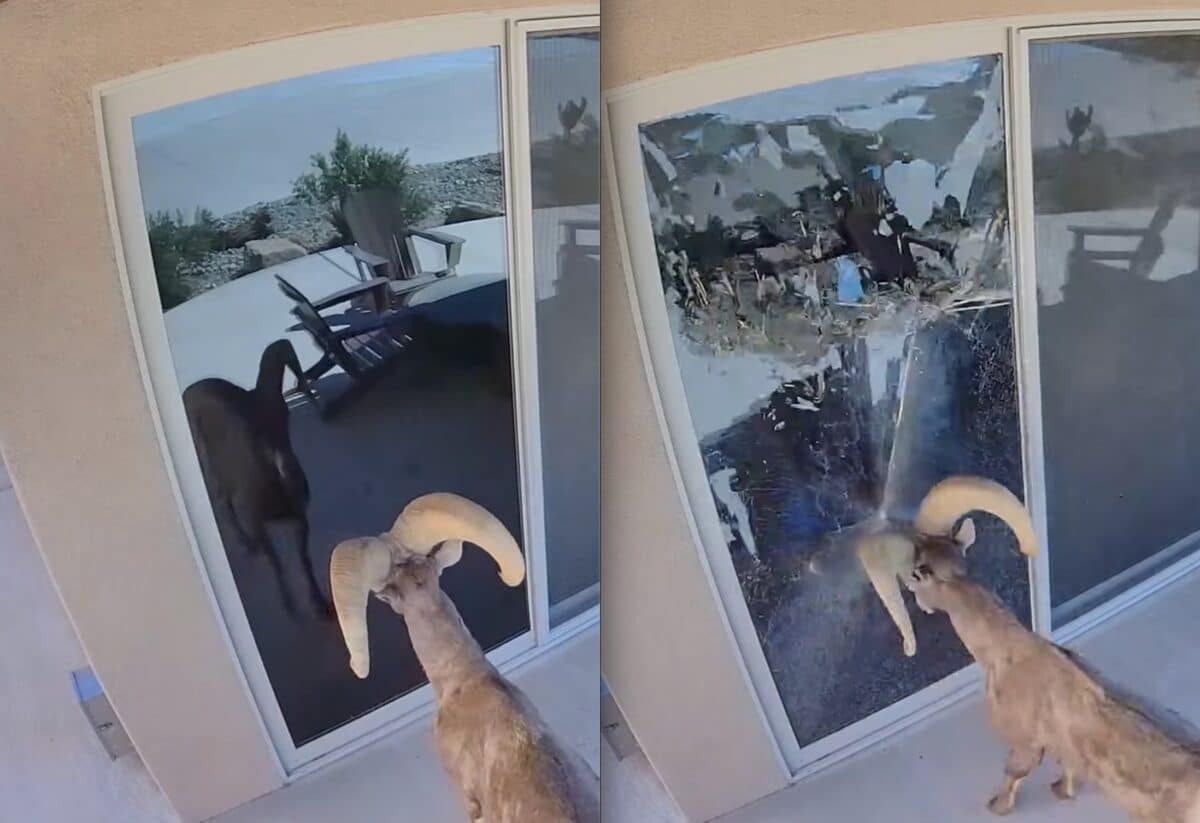
Yuma, Arizona — A simple case of mistaken identity led to a smashed sliding patio door for this man in Arizona.
Daniel Lapage captured the following video from a security camera at his residence in of Yuma, Arizona of a pair of bighorn sheep wondering around his property on April 2, 2026. Everything is fairly calm until a large ram caught his reflection in a sliding door and stopped in his tracks. Bighorn sheep are famous for sparring with each other in day long headbutting battles to establish dominance, determine social hierarchy, and gain mating rights with females and it looks like this fella took issue with the reflection and felt the need to address it.
Unfortunately for the homeowner, the reflection did not backdown and the ram accepted its challenge. In a swift lunge it lowered the boom and smashed the glass like it was nothing. Startled by the result, the ram took off in the opposite direction and if you look closely at its friend off on in the upper left corner, it too was spooked and booked it over some landscaping rocks:
About Arizona Bighorn Sheep:
Rocky Mountain bighorn rams can weigh up to 340 pounds while the ewes are much smaller. A full grown male may stand over 3 feet tall at the shoulder. For both desert and Rocky Mountain bighorn, the biggest visual difference between the sexes is the horns.
Ewe horns are generally 10 to 13 inches long with a circumference of 5 to 6 inches. Ram horns are much bigger measuring 30 to 40 inches along the outside curl with a basal circumference of 13 to 15 inches. The horn core is honeycombed with chambers, or sinuses, which reduce the weight of the skull.
At their peak, North American bighorn sheep numbers were estimated at 2 million. Desert populations have since fallen to about 20,000 and Rocky Mountain populations are at about 45,000. Arizona’s bighorn population, consisting of both desert and Rocky Mountain races, is estimated at 6,000 animals. The causes for this decline, which occurred primarily between 1850 and 1900, were competition with livestock for food and water and exposure to livestock associated parasites and diseases.
