

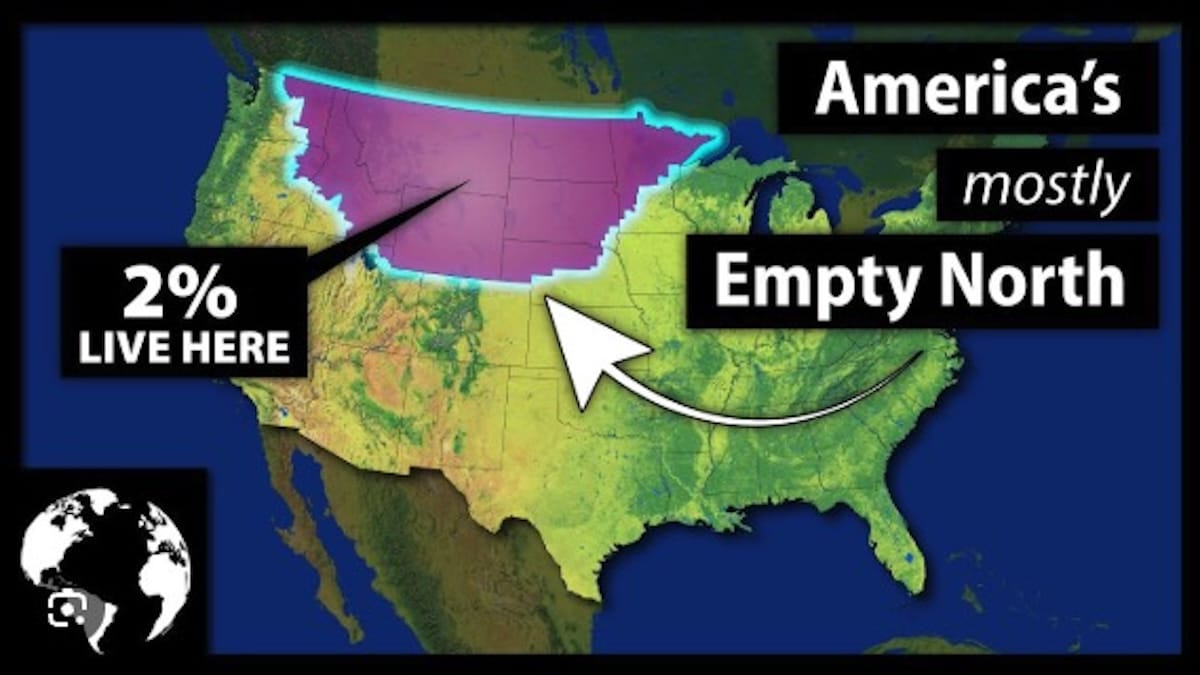
Despite taking up nearly 20% of the continental United States, the “Empty North”, which spans Montana, Wyoming, North Dakota, and parts of Washington, Oregon, Idaho, Nebraska, South Dakota, and Minnesota, contains just 5.6 million people. Massachusetts, which occupies less than 1% of this 553,000 square mile area, has 7 million residents. Geography by Geoff explored why this massive region is so empty.
Why The “Empty North” Is So Empty
Two distinct geographical challenges define this region. The western portion features the rugged Rocky Mountains, fragmenting potential settlement areas while the eastern half sits in the mountains’ rain shadow, creating arid conditions across the Great Plains. Even successful cities follow a pattern, located at the base of mountains rather then within them. Spokane (600,000 metro population) sits west of the Rockies, while Billings lies to the east. Missoula, the largest city entirely within the range, has just 117,000 people.
The Empty North also had a historical disadvantage, with development lagging from the start. Unlike other western territories that had “boosters” promoting settlement like Oregon’s Willamette Valley, Montana, Wyoming, and the Dakotas lacked early population magnets. The region’s chaotic territorial organization didn’t help. These lands passed through multiple territories before formal organization in the late 1800s, putting them at a permanent disadvantage.
Additionally, the Köppen climate classification describes the Empty North as “cold snowy regions and cold arid regions and little else.” Americans consistently choose warmer climates, driving explosive growth in California, Arizona, Texas, and Florida.
Interestingly though, just north of this region, Calgary and Edmonton thrive as Canada’s fifth and sixth largest metros. Mid-20th century oil discoveries fueled their growth. While the Empty North has oil fields, they’re neither as large nor as accessible. Without major resource discoveries or economic transformations, the Empty North will likely remain sparsely populated.
