

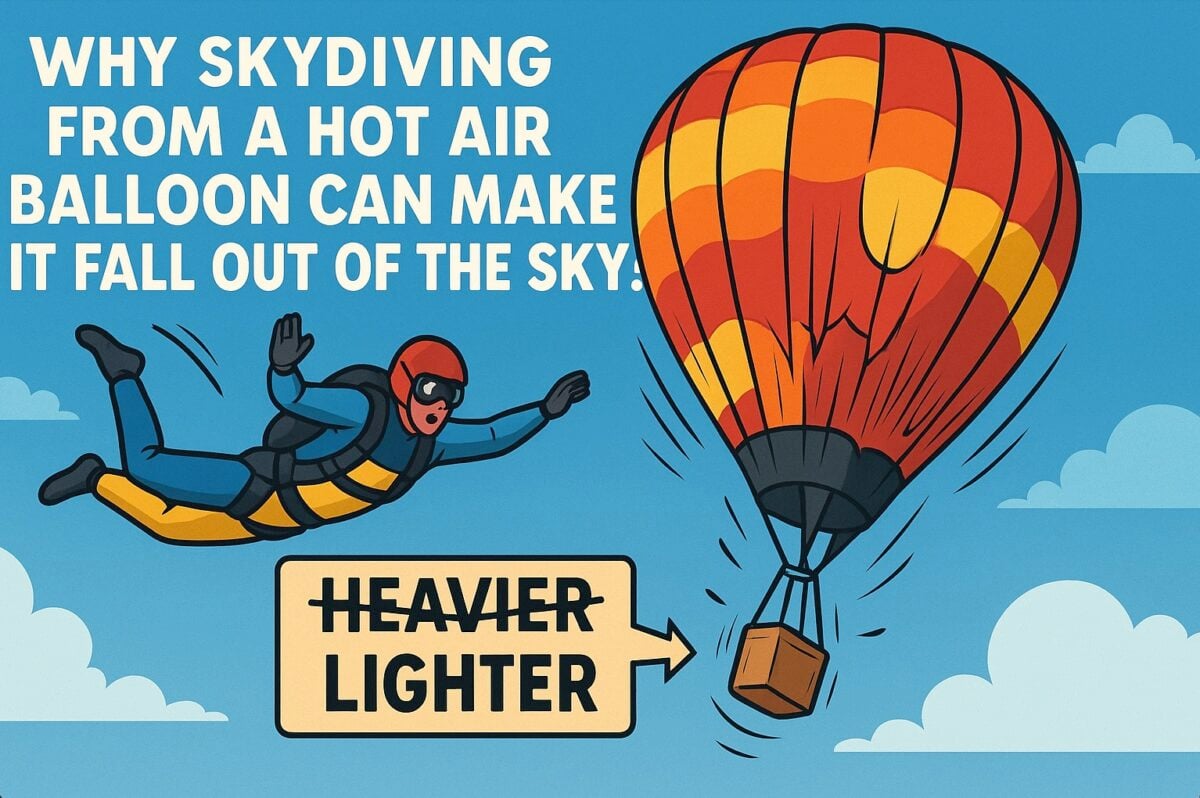
Why Skydiving from a Hot Air Balloon Could Be Deadly
Skydiving from hot air balloons looks thrilling on social media, but the physics behind it can turn deadly fast. Here’s why this extreme activity is far more dangerous than jumping from a plane—and why most experts strongly advise against it without specialized equipment and procedures.
The Hidden Danger: Sudden Weight Loss Triggers Violent Ascent
Hot air balloons rely on precise buoyancy control. They’re essentially giant bags of hot air, with no engines or wings to stabilize them like airplanes.
When a skydiver (typically 180–250 lbs with gear) exits:
- The balloon instantly loses significant weight.
- Buoyancy surges, causing a rapid uncontrolled climb—sometimes at rates exceeding 2,000 feet per minute (normal ascent is just 200–400 ft/min).
This “balloon bounce” or yo-yo effect deforms the envelope (the fabric balloon part). Cold denser air rushes in from the bottom, cooling the hot air inside rapidly.
Result? The balloon can partially or fully deflate, losing lift and entering a high-speed descent—sometimes faster than the skydivers falling below.
Real-Life Catastrophes: Not Just Theory
- January 2024, Eloy, Arizona: A Kubicek A-160 balloon carrying 13 people (8 skydivers, 4 passengers, 1 pilot) crashed in the desert, killing 4 and critically injuring 1. All skydivers had successfully jumped moments before. Witnesses saw the envelope partially deflate after the exits, leading to a catastrophic freefall from thousands of feet. The NTSB investigation pointed to envelope distortion from rapid ascent and possible issues with the deflation system.
- Other incidents: Pilots have reported near-misses with violent climbs causing “parachute stalls” (where the top valve collapses), basket flips, or emergency descents at 3,000+ ft/min. Organizations like the British Balloon and Airship Club and FAA discourage unmodified balloon skydiving due to these risks.
Even when done “intentionally,” the sudden mass change is unforgiving. In planes or helicopters, the aircraft’s structure absorbs the exit force—balloons can’t.
How Pros (Rarely) Do It Safely
A few specialized operators worldwide offer balloon jumps, but only with major modifications:
- Custom envelopes with quick-closing top valves
- Simultaneous ballast drops to counter skydiver weight
- Exits during controlled descent (never ascent)
- One jumper at a time, with expert pilots ready to blast heat
Even then, it’s considered one of skydiving’s riskiest variants. FAA regulations (under 14 CFR Part 105) allow parachute operations but don’t specifically address balloon-unique hazards—leaving much to pilot judgment.
Is Hot Air Balloon Skydiving Worth the Risk?
For most people: Absolutely not. Stick to airplanes for skydiving—they’re designed for it, with stable exits and no buoyancy surprises.
If you’re chasing that silent, serene freefall from a balloon, research operators meticulously and understand the physics. One wrong move, and the balloon can fall faster than you do.