


La Niña continued to hold strong on the Pacific into November, strengthening over the past month, but NOAA’s Climate Prediction Center reports that its weakness means conventional winter La Niña patterns may not fully materialize. At this point there’s a 60% chance of a transition to ENSO-neutral between January and March of 2026.

La Niña Strengthens
La Niña conditions continued to intensify through November, with below-average sea surface temperatures strengthening across the central and eastern equatorial Pacific. The Subsurface temperatures show persistent cold anomalies, bringing below-average conditions from the sea surface down to 200 meters depth across the eastern equatorial Pacific.
The atmospheric response show La Niña’s presence, with low-level easterly winds and upper-level westerly winds dominating the equatorial Pacific as enhanced convection persists over Indonesia and suppressed convective activity lingers near the Date Line. The traditional and equatorial Southern Oscillation indices both registered positive values, confirming the coupled ocean-atmosphere system reflects the pattern’s conditions.
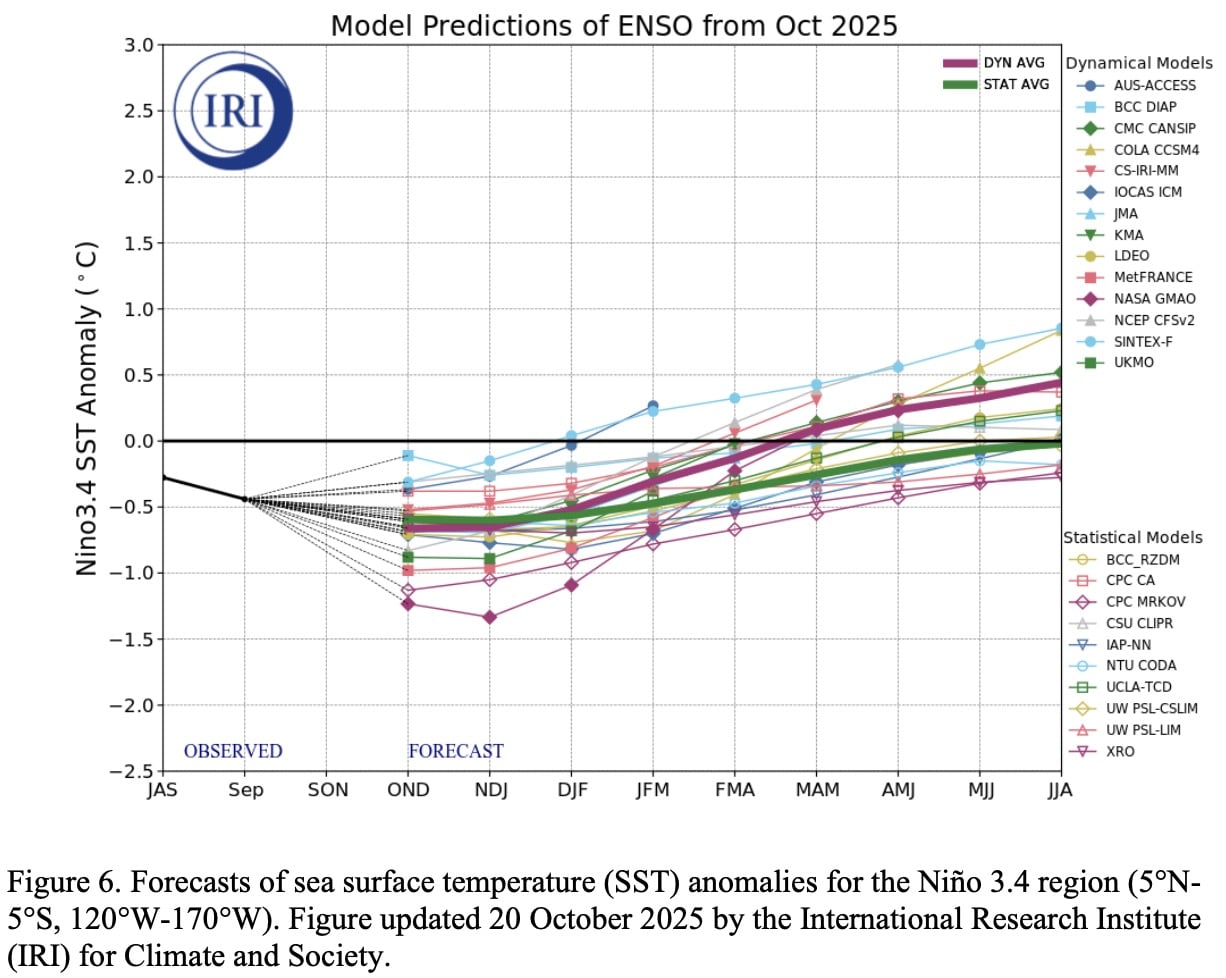
The International Research Institute (IRI) multi-model prediction and the North American Multi-Model Ensemble both indicate that La Niña will continue through December 2025 and February 2026, but forecasters emphasize that uncertainty for the time period is unusually high. The pattern only has a 51% chance, while ENSO-neutral has a 48% chance.
How Will This Impact The Winter?
With La Niña expected to remain weak through the winter, conventional weather impacts that are typically associated with years with the pattern are less likely. During a typical La Niña winter, the northern Rockies, Cascades, and Pacific Northwest tend to see above-average snowfall while the Southwest and southern states see drier, warmer conditions. But with the weakness of this event, combined with the forecasts’ high uncertainty, those patterns could be muted or inconsistent. However, predictable signs from the weak pattern could still nudge the forecast in certain directions.