

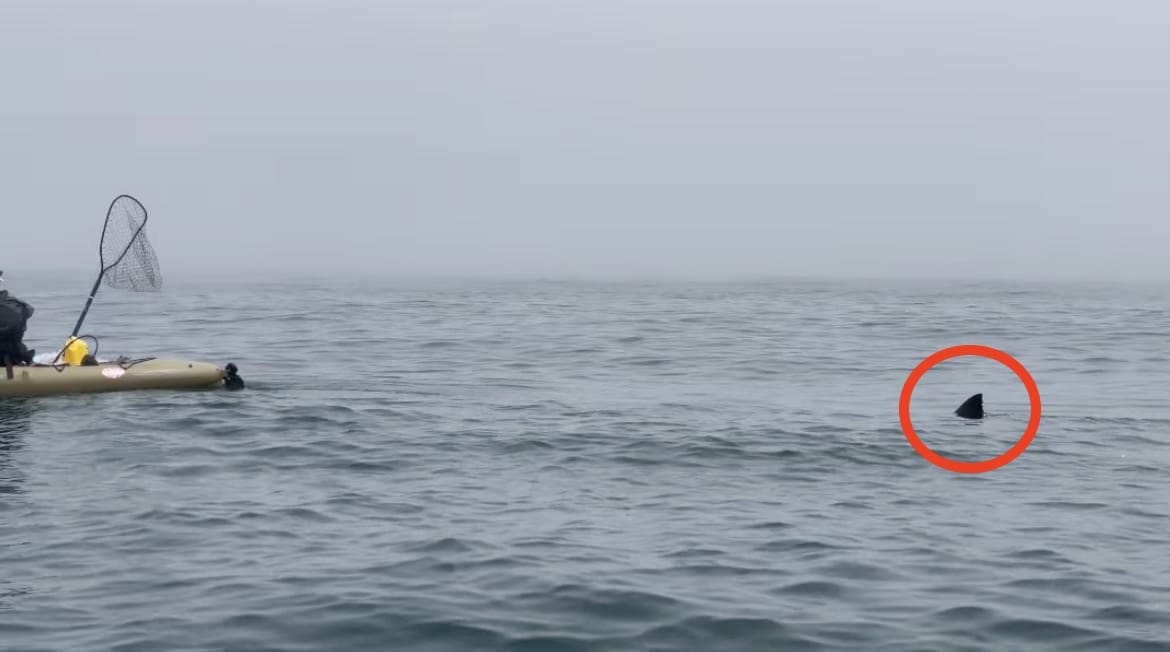
HALF MOON BAY, California – Two kayakers caught a pretty intense shark encounter on camera while on the water off Pillar Point Harbor in Half Moon Bay, California. While the shark doesn’t attack the kayakers at all, you can tell they’re both fairly spooked by and quite respectful of the animal’s size.
The video, shared to Instagram by musician and teacher ‘Headphone Hair‘ (Ian Walters), does not identify the type of shark encountered, though the animal is pretty clearly larger than the kayak (13 feet). Several comments identify it as a white shark, with one pointing out that the dorsal height and shape, tail height, and location are all right for it to be a white.
Walters spoke with KTVU following the incident, explaining that while the encounter could have certainly gone south, he felt the shark was rather curious and peaceful through it all.
“As a teacher, I feel passionately about disrupting harmful white shark stereotypes. This shark was bigger than our kayaks, and yet was totally peaceful and curious.” – Ian Walters
White sharks, commonly referred to as ‘great white sharks’, can get up to 20 feet in length, but that’s reserved for the biggest beasts. According to the Smithsonian National Museum of Natural History, average female white sharks are around 15-16 feet long, while the average male is around 11-13 feet. The largest shark in the world, the whale shark, averages between 18 and 32 feet long, with the longest ever measured accurately sitting at 61.7 feet (they’re harmless to humans, don’t worry).
California Department of Fish & Wildlife on Avoiding Shark Incidents:
“There is only one guaranteed method for avoiding a shark interaction: stay out of the ocean. While most white shark incidents have occurred at the surface, there have also been incidents between sharks and divers underwater. Scientists agree that most white shark incidents with humans are not predatory attempts, but rather the result of exploratory bites from sharks investigating unusual objects in their environment, such as kayaks. The other cause is believed to be sharks mistaking a person for their usual prey – a seal or sea lion. Juvenile sharks, which can be as long as 10 feet, sometimes charge and “bump” larger objects, potentially as a learning exercise as they begin to transition to larger marine mammal prey. Swimming in areas where sharks have been observed or where white sharks have been seen feeding is not recommended.“