

Lindsey Vonn’s decision to continue skiing at the highest level while dealing with catastrophic injuries remains one of the most jaw-dropping feats in modern sports. Just days before the 2026 Winter Olympics, Vonn suffered a complete rupture of her anterior cruciate ligament (ACL) during a World Cup downhill crash in Crans-Montana, Switzerland. The ACL is one of the most critical stabilizing ligaments in the knee, especially for alpine skiing, where athletes endure extreme torque, vibration, and speeds exceeding 80 mph. A full tear is typically a season-ending — and often career-ending — injury. For most athletes, the diagnosis would immediately trigger surgery and a year-long rehabilitation. For Vonn, it became yet another obstacle she chose to ski through.
Medical experts have repeatedly emphasized just how dangerous skiing without a functioning ACL can be. The ligament is essential for preventing the knee from collapsing under rotational force, and without it, even small mistakes can spiral into major trauma. Despite this, Vonn made the controversial and courageous decision to compete at the Olympics with a completely unstable knee, relying on muscle strength, bracing, pain tolerance, and years of elite body awareness to hold everything together. Doctors have described the feat as medically extraordinary, noting that very few athletes — in any sport — would even consider attempting it.
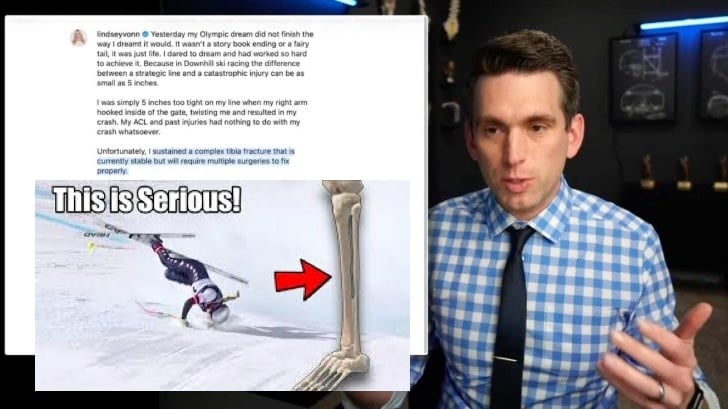
Tragically, that gamble ended in devastating fashion. During the women’s downhill event at the Milano Cortina 2026 Winter Olympics, Vonn crashed just seconds into her run. The fall resulted in a serious fracture to her left leg, the same leg already compromised by the ruptured ACL. She was quickly attended to on the course and ultimately airlifted from the mountain, a sobering scene that underscored the brutality of the sport and the risks she had knowingly accepted. The fracture required multiple surgeries to stabilize the damage, turning what was already a monumental injury into a complex, long-term recovery process.
The combination of a torn ACL and a broken leg on the same side presents enormous challenges, both physically and psychologically. Doctors explain that recovery from either injury alone is grueling; together, they compound instability, muscle loss, and rehabilitation timelines. Still, even in the aftermath of the crash, Vonn’s toughness and willingness to push her body beyond conventional limits have drawn widespread admiration. Her story is no longer just about medals or podiums — it’s about the extreme cost of elite competition, the thin line between resilience and risk, and one of the most fearless athletes alpine skiing has ever seen.
You don’t need to listen to Sutterer to know that this crash and injury was a brutal and devastating one. We’re wishing Vonn the best as she goes through these surgeries and works on recovery.
