

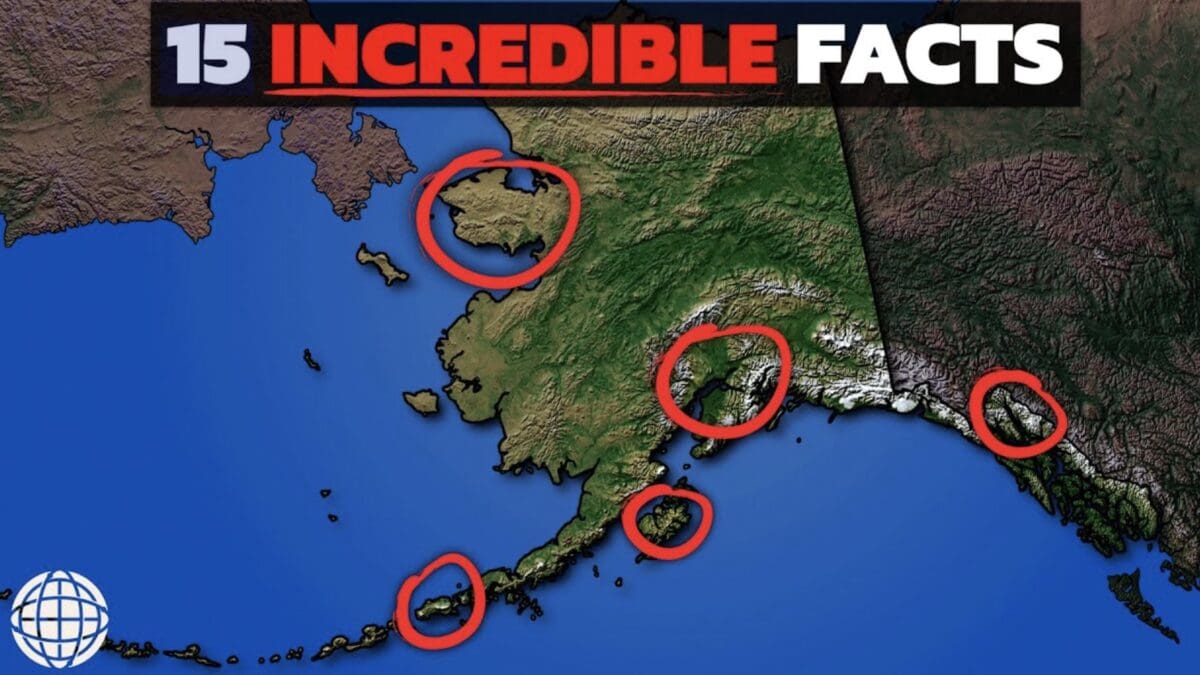
Alaska is by far the largest U.S. state, sitting as larger than Texas, California, and Montana combined. It’s no surprise, then, that it’s packed full of fascinating geography facts. YouTuber Geography by Geoff broke down and presented 15 of the most interesting he could find.
15 Geography Facts About Alaska:
- Alaska is the largest U.S. state, spanning over 663,000 square miles, larger than Texas, California, and Montana combined, making it the 17th largest country if it were independent.
- Alaska’s vast size creates a landscape of extremes, including icy coastlines, towering mountains, expansive tundra, and thick boreal forests, making infrastructure development challenging.
- Due to its size, many Alaskan towns are only accessible by air or boat, and the state has about as many airports as California despite having less than 2% of its population.
- Alaska’s massive size influences climate systems, ecosystems, and time zones, dwarfing the notion that “everything is bigger in Texas.”
- Alaska has more coastline than the rest of the United States combined, totaling over 33,000 miles, including its mainland and thousands of islands.
- The state’s coastline, stretching from temperate rainforests near Juneau to icy Arctic shores, supports rich marine ecosystems and industries like fishing, tourism, and shipping.
- At its closest point in the Bering Strait, Alaska is just 2.4 miles from Russia, with Little Diomede and Big Diomede Islands separated by the international date line.
- Alaska’s proximity to Russia, once a Russian colony until sold to the U.S. in 1867 for $7.2 million, had geopolitical significance, especially during the Cold War.
- Denali, standing at 20,310 feet, is North America’s highest peak, generating its own weather systems and posing significant mountaineering challenges.
- Alaska is part of the Pacific Ring of Fire, hosting over 130 active volcanoes, with eruptions that can disrupt global air traffic due to ash plumes.
- Alaska experiences more earthquakes than any other U.S. state, with over 20,000 annually, including the 1964 Good Friday earthquake, the second largest ever recorded at 9.2 magnitude.
- Alaska is home to approximately 3.5 million lakes, far surpassing Minnesota’s “10,000 lakes,” with Lake Iliamna alone spanning over 1,000 square miles.
- Over 100,000 glaciers cover about 5% of Alaska’s surface, acting as freshwater reservoirs and recording environmental data, though many are retreating due to climate change.
- Alaska holds the U.S.’s northernmost, easternmost, and westernmost points, with parts like Cape Wrangell on Attu Island lying in the Eastern Hemisphere.
- Alaska’s Arctic Circle territory experiences extreme climate conditions, including two months of darkness or daylight in places like Utqiaġvik, with rapidly warming temperatures impacting global climate and geopolitics.
