

Researchers from the University of Wyoming have found a way to peer beneath Yellowstone’s famous hot springs without drilling a single hole, using a geophysical technique that sends electrical signals into the ground.
According to the USGS Yellowstone Volcano Observatory, the method, called Electrical Resistivity Tomography (ERT), works by measuring how strongly underground materials resist the flow of electric current. Hydrothermal water conducts electricity well, so zones of low resistivity signal areas saturated with hot water. It’s a noninvasive approach that suits Yellowstone perfectly, where disturbing the ground carries serious risks.
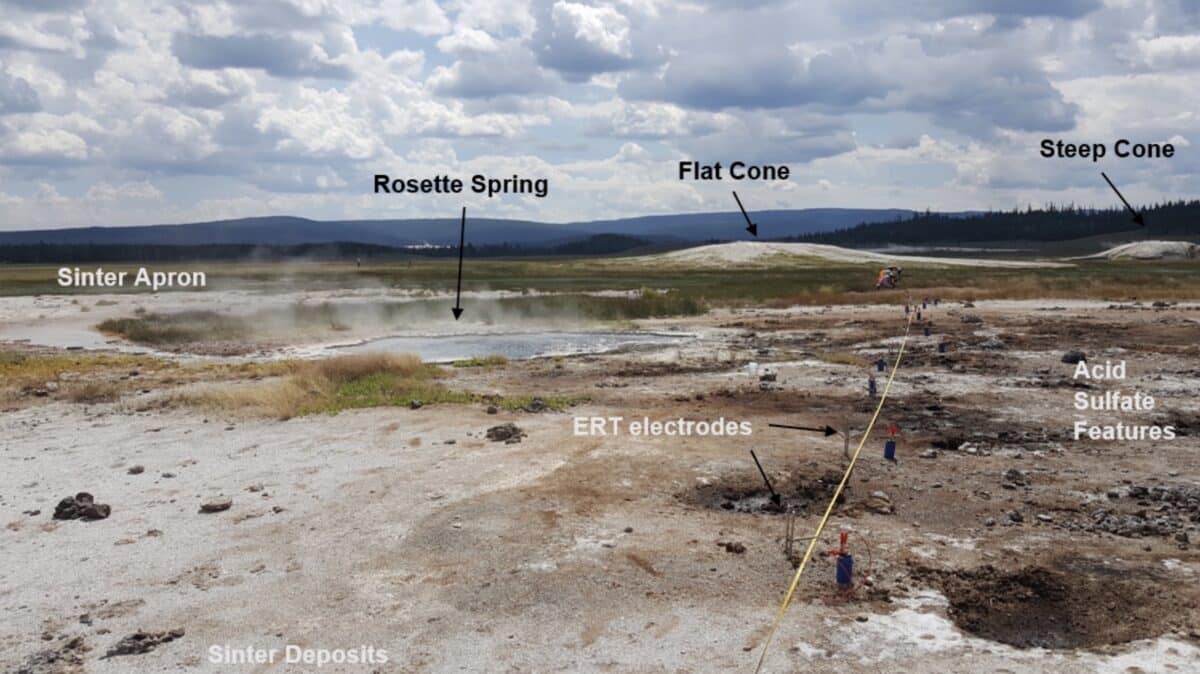
In 2018, a team of students and professors hiked two miles into Sentinel Meadows in the Lower Geyser Basin carrying heavy geophysical equipment to survey the area beneath Rosette Spring, also known as Bison Pool. They laid out five parallel lines of electrical sensors across the site and built a subsurface image of the hydrothermal system below.
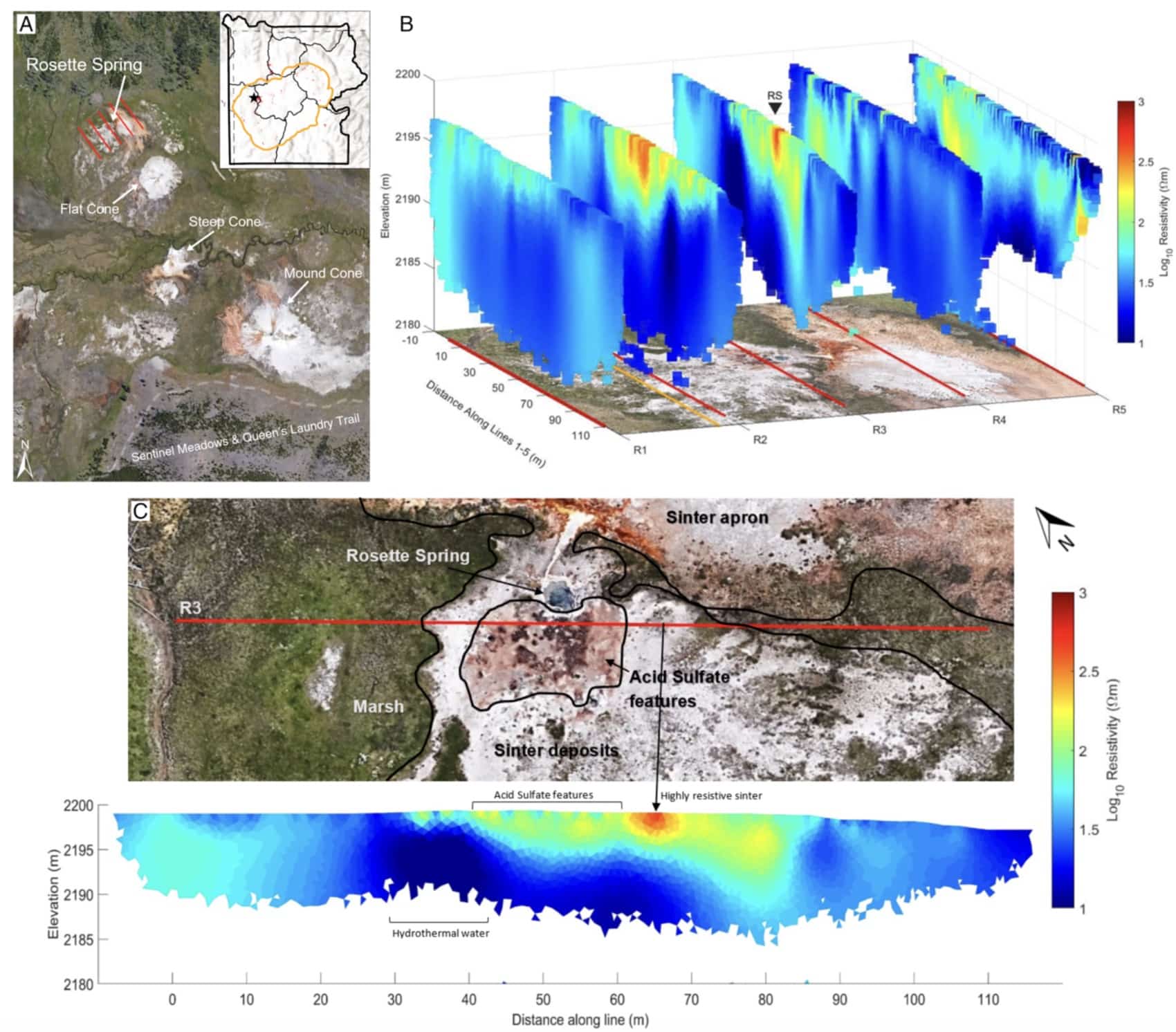
The results were in some ways both revealing and puzzling. Hydrothermal water sits roughly 5 to 10 meters underground near Rosette Spring, but the data showed no distinct pipe or conduit connecting that water to the pool at the surface. The leading interpretation is that water reaches the spring by traveling through a dense network of tiny pathways within the glacial deposits that make up the area’s surface geology. Those pathways are too small to be detected with current equipment.
The survey also showed that white sinter deposits visible on the ground extend roughly 7 meters into the subsurface. Sinter forms when hot spring water cools and precipitates silica, and its presence both above and below ground gives researchers a clearer picture of how these systems evolve over time.
The University of Wyoming has been conducting this type of ground-based geophysical research at Yellowstone for a decade. The work builds on drilling logs and rock cores collected during borehole surveys last conducted in 1967 and 1968, offering a modern, less invasive way to investigate one of the most dynamic hydrothermal systems on Earth.
