

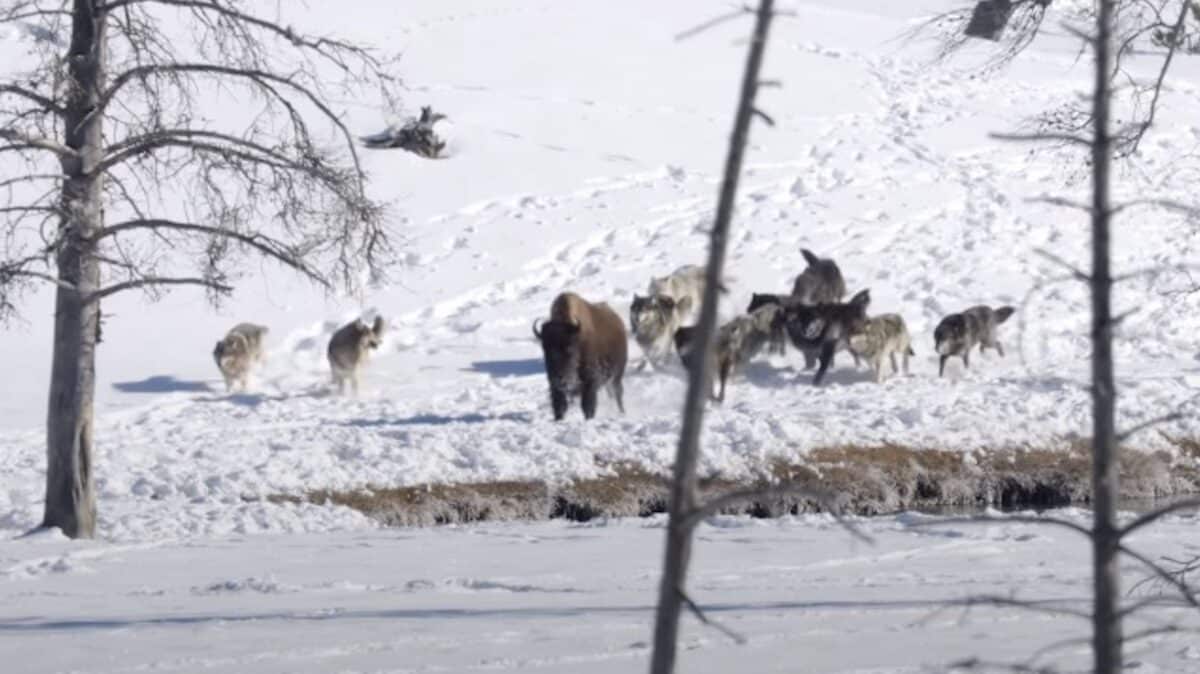
Yellowstone National Park, like most national parks, is a hotbed for wildlife activity. Bobcats, otters, cougars, bighorn sheep, elk, mountain goats, moose, beavers, and many, many more mammals can be found throughout the Yellowstone wilderness. Aside from the bears, though, no animals are quite as iconic as the wolves and bison.
Wolves were reintroduced to Yellowstone back in 1995 to restore native species and reestablish the essential ecological role of predation. Their removal in the early 20th century led to elk overpopulation, resulting in overgrazing and disruption of the natural food web. Today the wolf population fluctuates between around 83 and 123 individuals, inhabiting most of the park.
Yellowstone represents the only place in the United States where bison have lived continuously since prehistoric times. Thousands of individuals roam relatively freely throughout the park and some nearby areas, exhibiting wild behaviors like their ancestors. The large adult bison has only two predators: bears and wolves. Wolves employee cooperative hunting strategies to take down the massive animals, but, as seen in the video below, these hunts aren’t always successful.
Both bison and wolves, being wild animals, should always be given plenty of space by visitors to Yellowstone. Wolves typically aren’t a danger to people and will usually stay well away, but it’s vital that every person stays at least 100 yards, or 300 feet, from the predators at all times. Bison on the other hand can be quite a danger to visitors, injuring more people in Yellowstone than any other animal. Always give them at least 25 yards of space, and turn around and walk away if one approaches you. Read more on wildlife safety below.
Yellowstone Wildlife Safety:
Animals in Yellowstone National Park are wild and dangerous. Follow these regulations and guidelines to keep yourself, and the wildlife you may encounter, safe.
Never approach wildlife
The animals in Yellowstone are wild and dangerous, no matter how docile they may appear to be. The safest (and often best) view of wildlife is from inside a car. Always stay at least 100 yards (91 m) away from bears, wolves, and cougars, and at least 25 yards (23 m) away from all other animals, including bison and elk. If an animal moves closer to you, back away to maintain a safe distance. It’s illegal to willfully remain near or approach wildlife, including birds, within any distance that disturbs or displaces the animal.
Binoculars and telephoto lenses always give you a better view than approaching the animal would. Lenses with focal lengths of 300mm or greater are recommended for adequate reach.
Never feed wildlife
Never feed wildlife, even birds and squirrels. Animals that become dependent on human food may become aggressive toward people and have to be killed. Animals also carry diseases that can be transmitted to people.
Stay with your stuff
Don’t leave packs, bags, or coolers containing food unattended, even for a few minutes, as animals can learn new food sources quickly. Store these items in vehicles or bear-proof storage lockers, if available. Ravens have also learned to unzip or unfasten many different kinds of zippers and buckles to get to food.
Report all wildlife conflicts
If you’re involved in a conflict with an animal, regardless of how minor, contact us or report it to a park ranger as soon as possible. If cell service is available, dial 911. The lives of other people, and the animal, may depend on it.
