

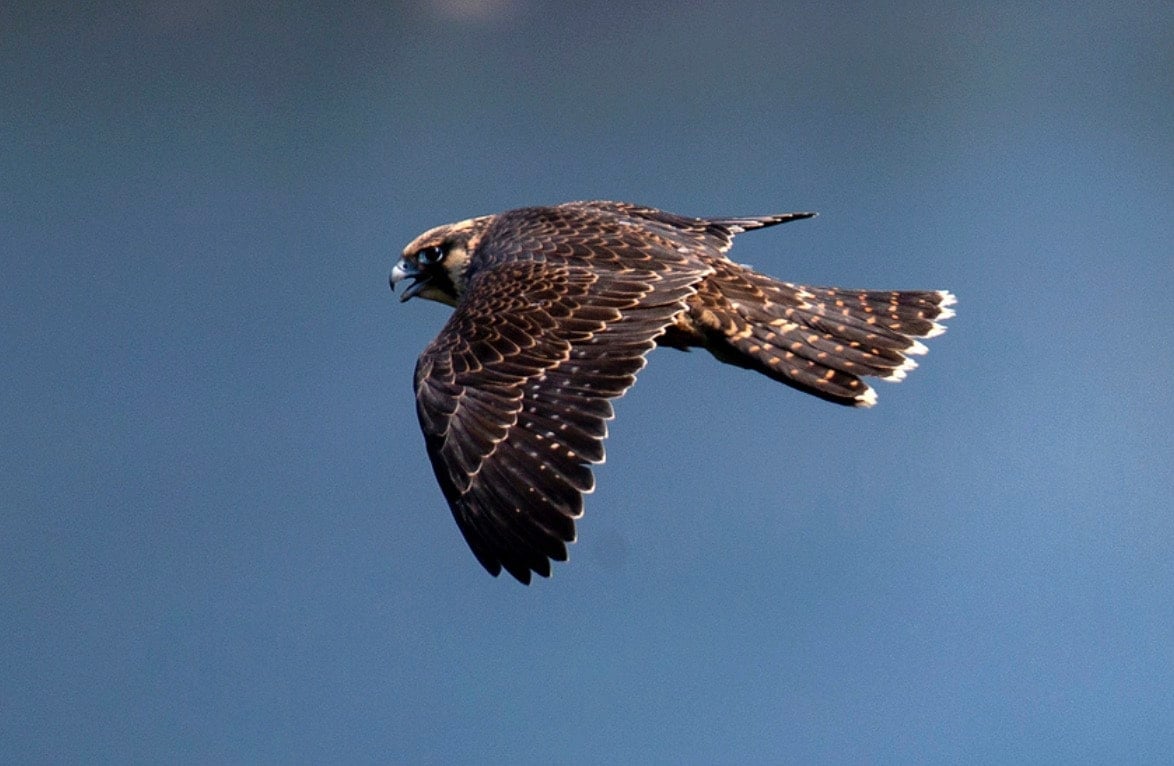
BAR HARBOR, Maine — The National Park Service has temporarily closed several popular trails in Acadia National Park to protect nesting peregrine falcons, officials said.
Beginning March 1, Jordan Cliffs Trail, Precipice Trail and Valley Cove Trail are closed until further notice. The Precipice Trail parking lot is also closed to vehicles.
Park officials said the annual closures are intended to prevent human disturbance during the falcons’ nesting period. Research shows nesting peregrine falcons are particularly vulnerable to nearby human activity, which can cause adults to become less attentive to eggs or chicks. In some cases, disturbance can lead to temporary or permanent nest abandonment, leaving chicks at risk of hypothermia, starvation or predation.
Signs posted at trailheads and junctions mark the closed areas. Entering a closed area is a violation of federal regulations and can result in fines, imprisonment or both. Park officials said the closures will be actively monitored and violations strictly enforced.
The trails will reopen once park resource managers determine it is safe for the birds.
In 2025, three breeding pairs of peregrine falcons nested on cliffs near Valley Cove Trail, Jordan Cliffs Trail and Precipice Trail. Two chicks from the Precipice Trail nest survived to fledging. The other two nests failed for reasons that may have included human disturbance.
More information about peregrine falcons in Acadia National Park is available on the National Park Service website.
Peregrine Falcons
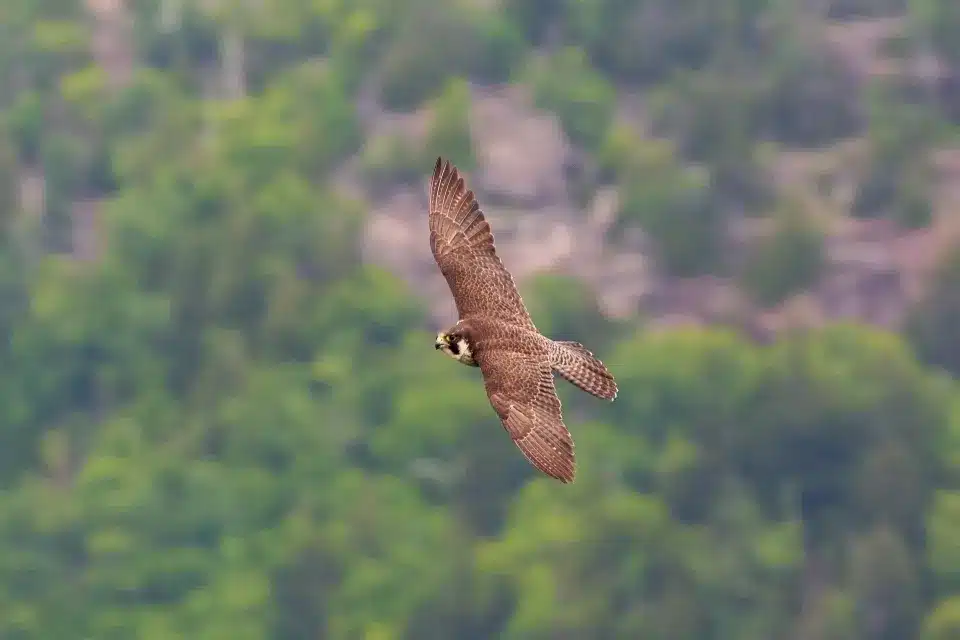
For centuries, peregrine falcons hunted the skies of the world, displaying their impressive in-flight hunting tactics. Imagine this crow-sized raptor flying high above its quarry, then diving (“stooping”) to attack prey at a speed of more than 100 miles per hour. Imagine the prey being struck to the ground or even killed in flight by the tremendous impact from the peregrine’s outstretched talons. Imagine witnessing a peregrine tail-chasing a dove between Dorr and Cadillac Mountains.
By the mid-1960s, researchers determined that peregrines were no longer a breeding species in the eastern United States. Nest robbing, trapping, and shooting first contributed to their downfall, followed in the 1950s by ingestion of chemical pesticides and industrial pollutants. Occupying a position high on the food chain, peregrines are still exposed to high levels of chemical residues if they migrate to or eat migrant song birds from countries using pesticides now banned in the United States. As in other birds of prey, ingested chemical toxins accumulate in their bodies, causing reproductive failure and leading to the decline and eventual endangerment of the species.
Peregrines at Acadia National Park
Peregrines nested on Mount Desert Island at least as long ago as 1936. The last known nesting pair was reported in 1956. From 1984 until 1986, 22 peregrine chicks were successfully hacked in Acadia National Park from a high cliff face overlooking Jordan Pond. Adult peregrines often return to areas near their original hack sites, which was the case at Acadia. When an adult peregrine returned in 1987, the park discontinued the hacking program for fear that this adult would prey upon any released chicks.
From 1987 to 1990 adult peregrines returned to Acadia, but did not produce young. The first successful nesting at Acadia in 35 years occurred in 1991. Since that time, at least one and sometimes four pairs have produced young in the park, bringing the total to more than 160 chicks.
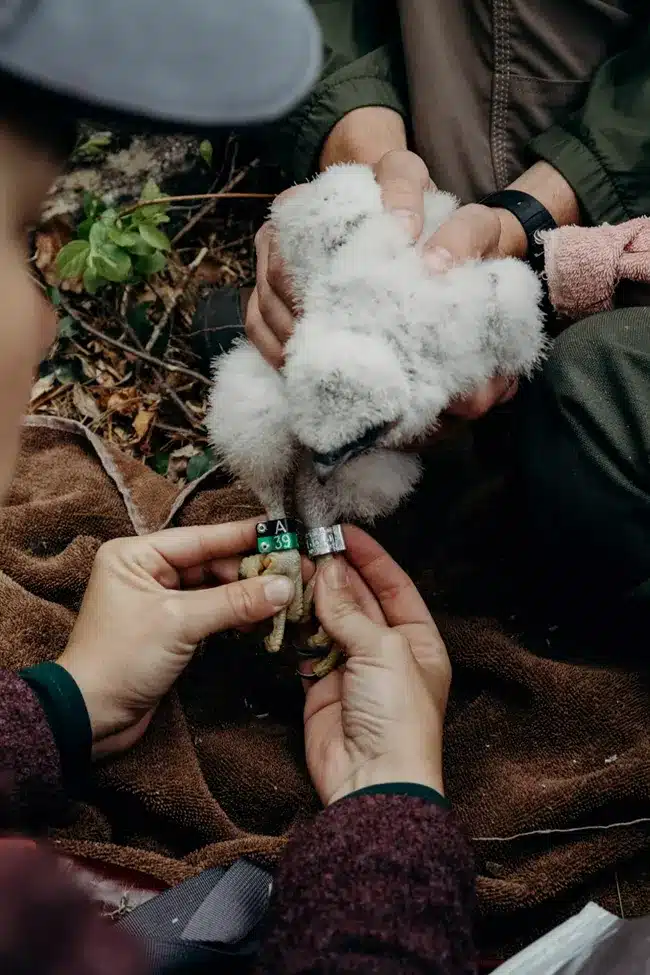
Many of the young have been banded to learn about peregrine migration, habitat use, and longevity. Birds banded in the park have been seen in Vermont, Maryland, Washington, D.C., and New Brunswick.
In early spring each year, park resource managers watch intently for signs of returning peregrines. If mating or nesting behavior is observed, certain trails are temporarily closed to avoid disturbance to the nesting area. These measures are helping this magnificent falcon make a triumphant comeback in Acadia National Park and contributing to the success story of the Endangered Species Act.
Field Marks
Wings: Long, pointed, sickle shaped. All falcons in a dive appear to have sickle-shaped wings. Wing shapes depend on the degree to which the bird is soaring or diving. Be careful in making identifications.
Head: Small with dark “sideburns”
Size: Crow-sized, female larger than male
Feet: Large (hence the nickname “big-footed falcon”)
Adult – yellow
Immature – light green
Plumage: Adult – white breast, dark gray back Immature – streaked breast, brown back
What can I do?
Help protect and promote the conservation of peregrine falcons:
- Learn characteristic field marks and behavior to make a positive identification.
- Stay away from areas where peregrines are nesting and report any person who fails to do the same. Avoid observing the birds from a location higher than the nest site. Adult peregrines generally won’t tolerate people above them and may dive at intruders, particularly if they are defending a nest or chicks.
- Observe trail and area closures. The Precipice, East Face, and Jordan Cliffs Trails and the northern section of the Flying Mountain Trail are usually closed from late spring to summer. Check the park current conditions and trail closures for up to date information.
