

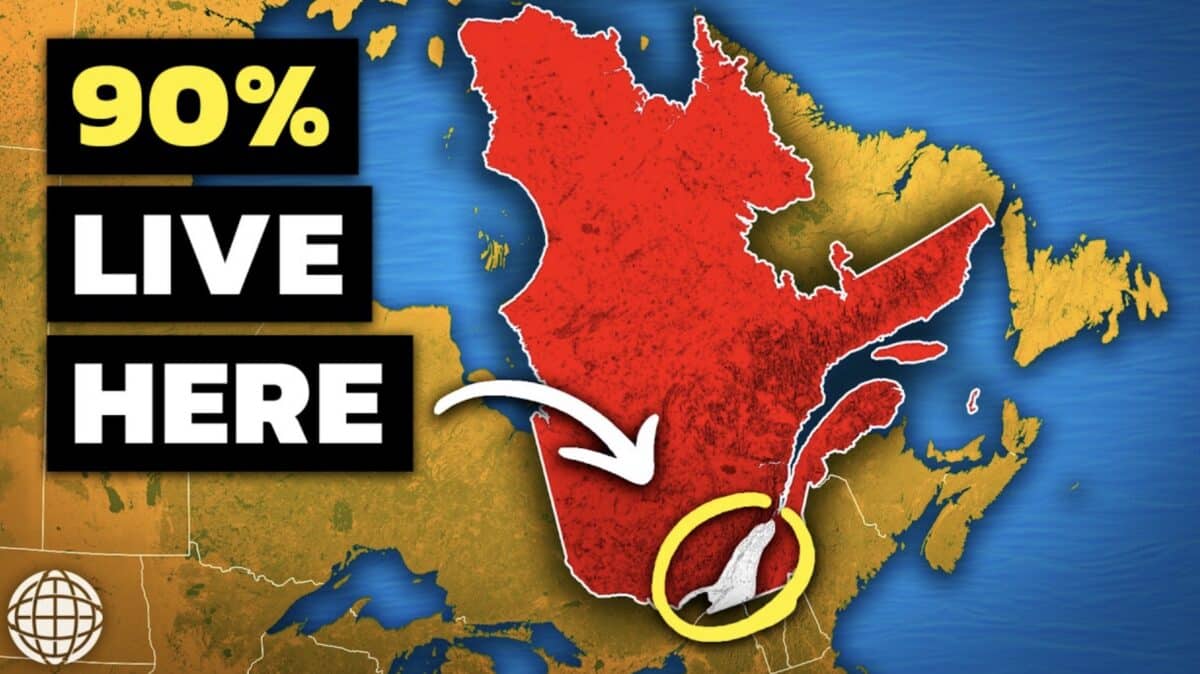
Quebec is an extraordinary province, holding a staggering 3% of Earth’s entire freshwater supply, harboring a meteorite crater visible from space, and powering New York City with clean hydroelectric energy. Despite covering an area three times the size of France, roughly 90% of its 8.5 million residents are packed into a single narrow strip of land along the St. Lawrence River. Geography By Geoff took a look at 15 incredible geography facts about Quebec that make this French-speaking giant one of the most geographically fascinating places on Earth.
15 Geography Facts About Quebec:
- The Eye of Quebec – The Manicouagan Reservoir, often called the Eye of Quebec, was formed by a meteorite roughly 5 km in diameter that struck Earth approximately 214 million years ago, creating a nearly perfect circular crater about 100 km wide that remains one of the few impact craters clearly visible from space.
- A Lake Within a Crater – Over millions of years, the center of the Manicouagan crater rebounded to form Rene-Levasseur Island, which is actually larger than the island of Montreal.
- The Rivalry of High Tides – Quebec’s Ungava Bay, a massive funnel-shaped cold inlet in the Nunavik region separating Quebec from Baffin Island, has recorded tides as high as 16.8 meters in the Leaf Basin, making it a legitimate rival to the Bay of Fundy for the title of world’s highest tides.
- Freshwater Colossus – Quebec holds approximately 3% of the world’s renewable freshwater reserves, containing more than 3 million bodies of water and roughly 40% of all the water in Canada.
- The Ancient Laurentians – The Laurentian Mountains, situated just north of Montreal, were formed over 1 billion years ago, making them among the oldest geological formations on Earth and predating the Rocky Mountains by nearly a billion years.
- Enormous Empty Land Mass – Quebec is the largest province in Canada by area, covering over 1.5 million square kilometers, making it approximately three times the size of France and roughly twice the size of Texas.
- The Meaning of “Kebec” – The name Quebec is derived from an Algonquin word meaning “where the river narrows,” referring to the geographic choke point on the St. Lawrence River near modern-day Quebec City that Samuel de Champlain recognized as a natural fortress and toll booth for all river traffic moving into the interior of the continent.
- The Only Walled City North of Mexico – Quebec City is the only city in North America north of Mexico to retain its original fortified walls, a 4.6 km stretch of ramparts preserved in the 1870s by Governor General Lord Dufferin for their historic and aesthetic value, contributing to the city’s UNESCO World Heritage status.
- The Great Earthquake of 1663 – The Charlevoix region of Quebec was the epicenter of a massive earthquake estimated between magnitude 7.3 and 7.9 in 1663, an event so powerful that it caused landslides altering the flow of rivers and church bells reportedly rang as far away as New England.
- The Seigneurial System – A 17th-century French land distribution system divided the St. Lawrence Valley into long, narrow strips perpendicular to the river, and the resulting barcode pattern of farm plots is still clearly visible in satellite imagery of the region today.
- The Vastness of New France – At its peak in the early 1700s, the territory administered from Quebec City stretched from Hudson Bay in the north through the Great Lakes and all the way down the Mississippi River to the Gulf of Mexico, with French place names like Detroit, Des Moines, and St. Louis serving as geographic echoes of that era across the American Midwest.
- Maple Syrup Monopoly – Quebec produces roughly 72% of the entire global supply of maple syrup, with the Federation of Quebec Maple Syrup Producers operating much like OPEC does for oil, even maintaining a high-security Global Strategic Maple Syrup Reserve to stabilize markets during poor harvest years.
- The “Main Street” Population – Roughly 90% of Quebec’s 8.5 million residents live in a narrow strip of land along the St. Lawrence River lowlands, with nearly 50% of the entire provincial population concentrated in the greater Montreal area alone.
- The Underground City – To survive winters where temperatures can drop below -30 degrees Celsius, Montreal constructed the RESO, the largest underground pedestrian network in the world, consisting of 32 km of tunnels connecting metro stations, universities, hotels, and hundreds of shops and restaurants.
- A Linguistic Island – Quebec is the only jurisdiction in North America with a French-speaking majority and a government that operates solely in French, with Bill 101 physically changing the landscape by legally requiring commercial signs to be predominantly in French, preserving a language that has thrived in the St. Lawrence Valley for over 400 years while surrounded by more than 350 million English speakers.
