

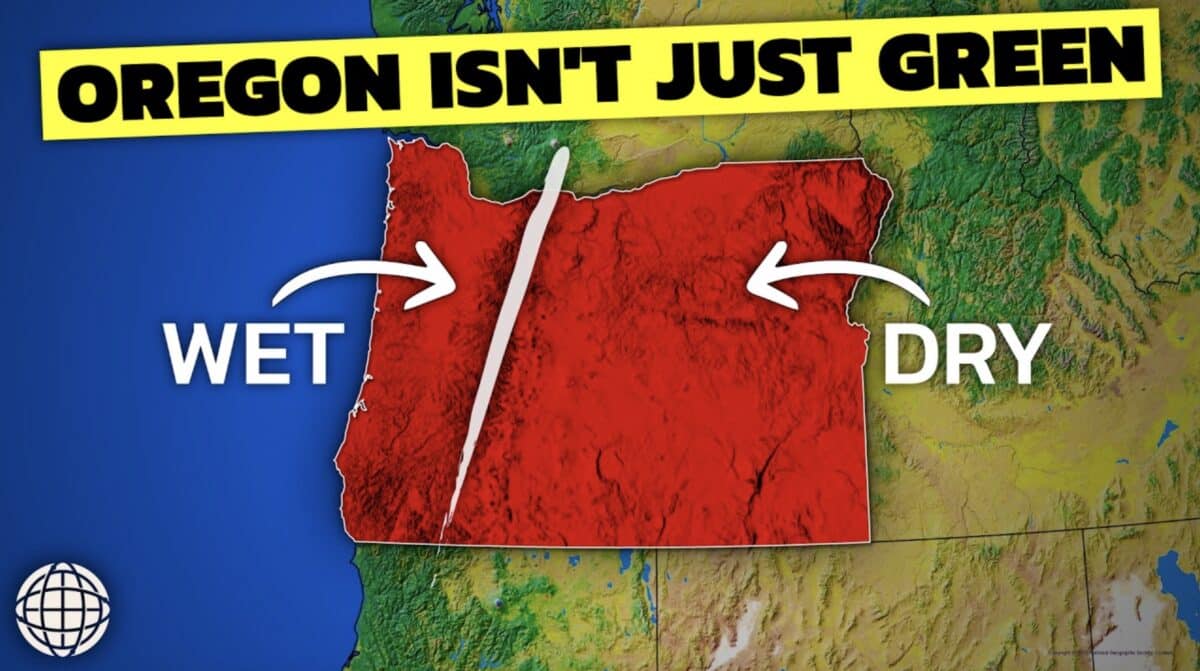
Oregon is an extraordinary state, with ancient volcanic lakes, towering coastal dunes, cataclysmic flood landscapes, and more. When comparing it to the other 50 states in the U.S., Oregon has some truly unique geography, from the deepest lake in America to a coastline where private property simply doesn’t exist. Geography By Geoff took a look at 15 incredible geography facts about Oregon that make the state stand out.
15 Geography Facts About Oregon
- The Abyss of Crater Lake – Formed by the violent eruption and collapse of Mount Mazama approximately 7,700 years ago, Crater Lake is the deepest lake in the United States at 1,949 feet and the 11th deepest in the world.
- A Lake With No Rivers – Crater Lake has no rivers flowing into or out of it, with its water level maintained entirely by a balance of evaporation and annual snowfall, resulting in a legendary, intense blue color.
- World’s Largest Living Organism – Hidden beneath the Malheur National Forest in eastern Oregon, a honey mushroom fungus colony covering 2,200 acres is potentially the world’s largest living organism by mass and volume, estimated to be at least 2,400 years old.
- North America’s Deepest Gorge – Carved by the Snake River along the Oregon-Idaho border, Hells Canyon reaches a staggering depth of 7,993 feet, nearly 2,000 feet deeper than the Grand Canyon.
- Legacy of the Missoula Floods – At the end of the last ice age, repeated catastrophic floods sent walls of water 400 feet high racing across the Pacific Northwest, carving the Columbia River Gorge and depositing the rich alluvial soil that made the Willamette Valley one of the most fertile agricultural regions on Earth.
- The Towering Oregon Dunes – Stretching 40 miles along the central Oregon coast, the Oregon Dunes National Recreation Area is the largest expanse of coastal sand dunes in North America, with some dunes reaching 500 feet above sea level.
- Ruts of the Oregon Trail – The wagon traffic of roughly 400,000 pioneers between the 1840s and 1860s was so heavy that the iron wheel ruts are still visible in the earth near Baker City today, serving as a permanent geographic monument to one of history’s greatest mass migrations.
- Astoria: The First Foothold – Founded in 1811 at the mouth of the Columbia River, Astoria is the oldest American settlement west of the Rocky Mountains, chosen for its strategic position at the gateway between the Pacific Ocean and the vast interior of the continent.
- The Portland Penny Flip – In 1845, the name of modern-day Portland was decided by a best-of-three coin toss between two landowners, one from Boston and one from Portland, Maine, and the city of “Boston, Oregon” was only one flip away from becoming a reality.
- The Lost State of Jefferson – Frustrated by geographic isolation and neglect from distant state capitals, residents of southern Oregon and northern California declared the independent State of Jefferson in November 1941, a movement that only ended when the attack on Pearl Harbor unified the country days later.
- Mysterious Origin of “Oregon” – The name Oregon is one of the greatest etymological mysteries in North American geography, with theories ranging from a French word for hurricane to a Spanish term given by explorers to a miscopied river name on an 18th-century map.
- The Hazelnut Capital – Thanks to the Willamette Valley’s rare combination of mild winters and volcanic soil, Oregon produces 99% of the entire U.S. supply of hazelnuts, earning the hazelnut its designation as the official state nut in 1989.
- The World’s Smallest Park – Mill Ends Park in Portland, a circle just 2 feet in diameter located in a street median, holds the Guinness World Record as the world’s smallest park, born from a 1948 journalist’s whimsical stories about a colony of leprechauns.
- A Two-Sided Flag – Oregon is the only state in the union with a two-sided flag, featuring the state seal on the front and a single golden beaver on the reverse, reflecting the fur trade origins that shaped its waterways and early exploration.
- The People’s Coast – Thanks to a 1913 law and the landmark 1967 Beach Bill, the entire 363-mile Oregon coastline is public land, making it one of the only places in the country where private ownership cannot block citizen access to the shore.
