

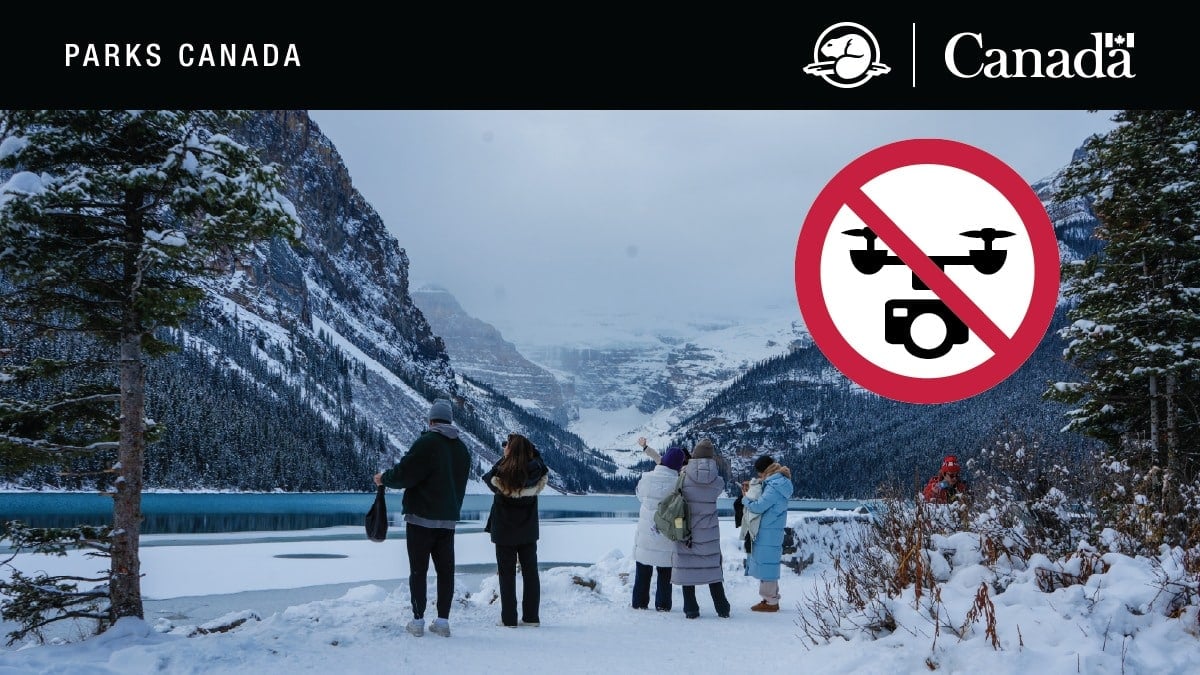
With commercially available drones becoming more and more prevalent in our airspaces, its important to know the laws that govern where and when they are flown and to abide by them at all times.
The following story out of Canada shows not only the legal consequences of illicit drone flights but also the potential danger they pose to air traffic. On January 17, 2025, Park Wardens patrolling Banff National Park received a report of a drone about to take off at Lake Louise. The reporting party took it upon themselves to alert the drone pilot that the activity was prohibited in the national park but they were ultimately ignored, despite “no drone” signage located nearby.
While responding to the report, Park Wardens witnessed the operator land the drone along the lakeshore. Park Wardens seized the drone, controller and storage card, and charged the operator with violating Section 2(4) of the National Parks of Canada Air Access Regulations which prohibits take-offs or landings of an aircraft in a park other than to land in the case of a diversion or other emergency situation.
Around the time of the illegal drone operation, Parks Canada Visitor Safety was conducting air operations in the same area for avalanche mitigation. A contracted helicopter transited the airspace with staff aboard within 30 minutes of the illegal drone operation.
Park Wardens obtained a search warrant to examine the drone’s microSD card. Upon investigating the footage and GPS data, Park Wardens confirmed the drone flight path geographically overlapped with the helicopter. In addition:
– The operator did not have a Parks Canada permit to fly the drone.
– The drone was not registered with Transport Canada.
– The operator did not have the required Transport Canada licenses.
– The drone was flown beyond the visual line of sight, hindering the pilot from knowing the drone’s position and movement relative to other aircraft, wildlife and visitors.
What was the penalty?
As a result of Parks Canada’s investigation the individual was ordered by the Court to pay a $2000 penalty after pleading guilty to flying a drone in a national park. Proceeds from this fine are directed into the Environmental Damage Fund, managed by Environment and Climate Change Canada, which allocates fines and penalties from environmental violations to projects that restore and protect the environment.
Under the National Parks of Canada Aircraft Access Regulations, the take-off and landing of a drone is illegal in a national park (aside from diversions or other emergencies). Additionally, a restricted activity order issued by the Superintendent under the Canada National Parks Act prohibits the operation of drones in Banff National Park, not just take-off and landing. As such, any use of a drone is illegal in the park without a restricted activity permit. Visitors are expected to know the rules and comply when visiting a national park.
Why are drones prohibited?
This case illustrates the serious public safety implications illegal drone operations carry. Drones can cause distress to wildlife in national parks, disturb visitors’ enjoyment and privacy, and pose serious risks to operational aircraft along with staff on board. Parks Canada must ground operational aircraft when an unauthorized drone is reported in the area. This delays national park operations and may put people in need of rescue or relying on the helicopter at greater risk. Collisions could result in catastrophic loss.
Parks Canada uses drones for limited operational purposes but does so under strict regulatory guidelines that mitigate impacts to wildlife and ensure safety for all. This includes monitoring air to ground communications and maintaining communications with other aircraft via Banff Dispatch.
If you see an illegal drone in the park:
Visitors can report illegal drone operations in Banff, Yoho, or Kootenay national parks to Parks Canada staff or Banff Dispatch: 403-762-1470. If you witness drone activity, while ensuring your own safety, you can help by gathering as much detail as possible including:
– identifying the pilot or drone operator (physical characteristics).
– taking photos or videos.
– noting a license plate if possible.
– recording any other relevant information.
