

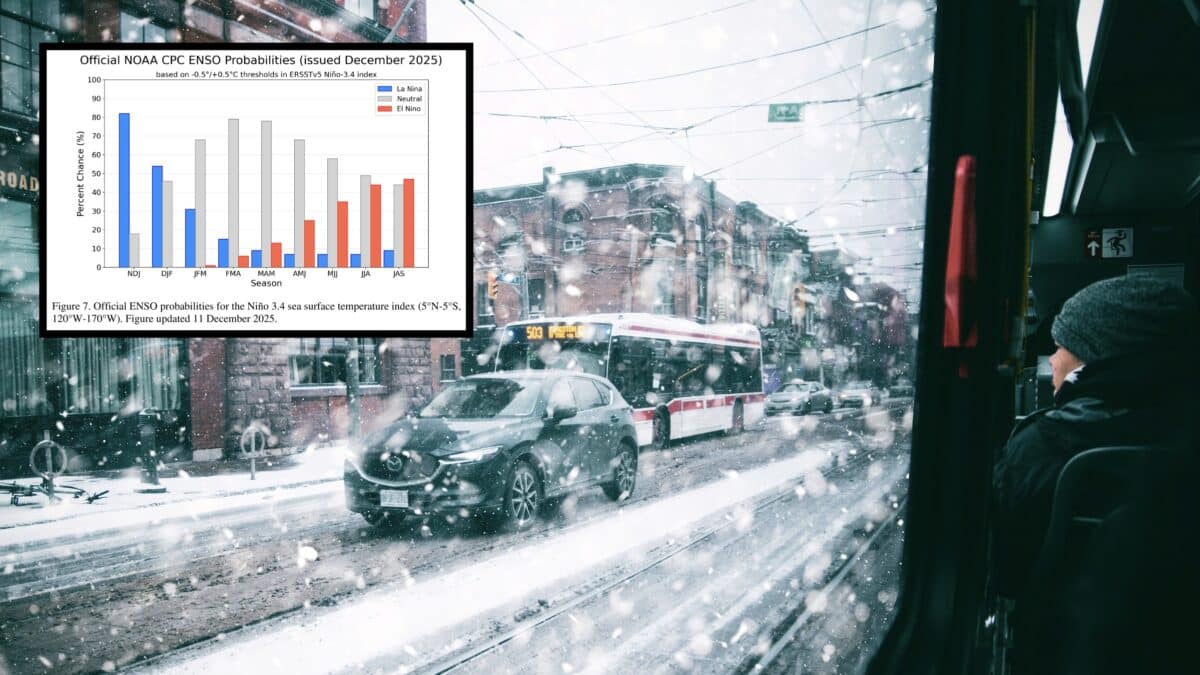
According to the National Oceanic and Atmospheric Association‘s Climate Prediction Center, La Niña persisted throughout November as indicated by the continuation of below-average sea surface temperatures across the central and eastern equatorial Pacific Ocean. The latest weekly Niño-3.4 index value was measured at -0.5°C, with other Niño index values ranging between -0.2°C and -0.4°C. Recent negative subsurface temperature anomalies weakened slightly, but below-average temperatures continued from the surface down to 200 meters depth in the eastern half of the equatorial Pacific.
Atmospheric Response Reflects La Niña
The tropical atmosphere reflected La Niña conditions, with low-level easterly wind anomalies evident in the central Pacific and upper-level westerly wind anomalies observed across most of the equatorial Pacific Ocean. Enhanced convection persisted over Indonesia while suppressed convection lingered near the Date Line. The traditional and equatorial Southern Oscillation indices both registered positive values. Collectively, the coupled ocean-atmosphere system remains consistent with La Niña.

Transition Expected in Early 2026
The International Research Institute multi-model predictions indicate that La Niña will continue during the December-February 2025-26 season, but ENSO-neutral conditions are favored for January-March 2026. The North American Multi-Model Ensemble supports a weak La Niña through December-February with a 54% chance, before transitioning to ENSO-neutral in January-March.
The forecast notes that even after equatorial Pacific sea surface temperatures transition to ENSO-neutral, La Niña may still have some lingering influence through the early spring 2026 in the Northern Hemisphere. La Niña is favored to continue for the next month or two, with a transition to ENSO-neutral most likely in January-March 2026 at a 68% chance.

What This Means for Winter
La Niña winters typically bring distinct weather patterns across North America, though the current weakness of this event means traditional impacts may be less pronounced. For skiers and snowboarders, Years with the pattern often favor the northern tier of the United States and Canada with above-average snowfall, while southern regions tend to see drier conditions. However, the expected early transition to neutral conditions by late winter could moderate these typical patterns before the ski season concludes.
