

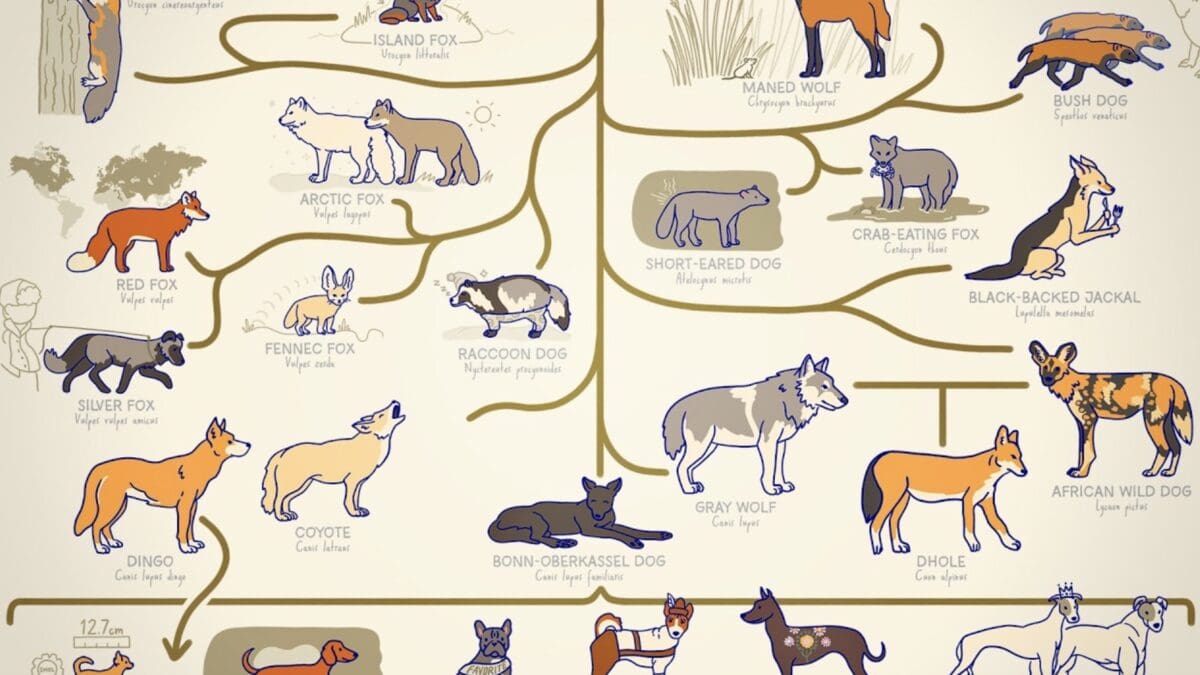
For many people, dogs are an integral part of their lives. Pet dogs bring joy, comfort, and a sense of responsibility to around 45.5% of the United States population. Working dogs assist on farms, avalanche rescue dogs save lives, and sniffing dogs help find potential dangerous devices. Dogs are everywhere, and that’s before even getting into wild canines. Wild canine live in every continent except Antarctica (though they aren’t native to Australia). But how did we get so many dogs in this world? MinuteEarth explored the origin of all of the dogs.
The Origin of Dogs
If you’re looking for a dog that’s the size of a grizzly bear, you’re looking for the Epicyon. Living across ancient landscapes, the Epicyon was the largest canine ever. The iconic dire wolf (fans of Game of Thrones know this one well), an apex predator of the American West, left hundreds of skulls in California’s La Brea Tar Pits after chasing trapped prey. Then there’s Leptocyon, the omnivorous ancestor that sparked the canine lineage over 30 million years ago in North America.
Today’s canines are equally varied. Gray foxes use long claws for tree-climbing to evade coyotes and wolves. Island dwarfism shrank their cousins, the island foxes of California’s Channel Islands, by about 25%. Red foxes are wide spread, found in North America, Europe, Asia, and beyond, with black or silver coats in some regions. Arctic foxes swap fluffy white fur for a sleeker summer coat, while fennec foxes survive in deserts with heat-dissipating ears and shovel-like feet.
Closer to our homes, gray wolves, likely the most famous wild canine, gave rise to domestic dogs around 15,000–30,000 years ago. Breeds like the Basenji, hairless Xoloitzcuintli, and drool-heavy Mastiff showcase human-driven diversity. Huskies run ultramarathons, while speedy Greyhounds hit 75 km/h. Chihuahuas, the world’s smallest breed, and the towering Great Danes highlight the spectrum. Mutts, like the spacefaring Laika, prove mixed breeds shine too.
