


Fairview, Utah — A non-profit is working on creating something that the Utah ski industry desperately needs: a feeder hill.
The Salt Lake Tribune reports that the Snowland Recreation and Education Area is making a comeback. This spot was once a public ski area with a couple of surface lifts, which operated from 1967 to 1980. While it was a popular ski area, the rapid increase in insurance costs and issues regarding permitting forced it to close. The land and forest service lease was taken over by Wasatch Academy. However, it has remained a popular hangout spot for sledders and snowboarders during the wintertime.
This popularity, though, has created hazardous driving conditions. The way State Route 31 winds around the ski area means that drivers would stop to drop off skiers and riders, and then go down to the base area to pick them up. These roads are crowded with various vehicles, such as snowmobiles. The frequent U-turns by drivers dropping off and picking up snowboarders have led to some crashes. With guests continuing to frequent Snowland, locals decided it was time for a revival.
Last week, a groundbreaking ceremony was held for the revival of Snowland. Local officials were present at the event, including Utah Governor Spencer Cox. The operation will be a volunteer-run ski area, led by the Snowland Foundation. So far, the project has raised $1 million from a grant via the State of Utah and around $220,000 from donations.
During the ceremony, details regarding the ski area were revealed. The first season will see the opening of two rope tow lifts to the public (which were previously used by Wasatch Academy) that will service two trails. The historic Nelson Lodge will serve as a spot for a small food and drink selection, along with bathrooms. For parking, an expanded lot has been created. Future phases could include a parking lot at the top of the hill, two yurts which would be available for overnight rentals, a restaurant, an outdoor concert space, and a third surface lift (likely a T-Bar) with carriers for mountain bikes.
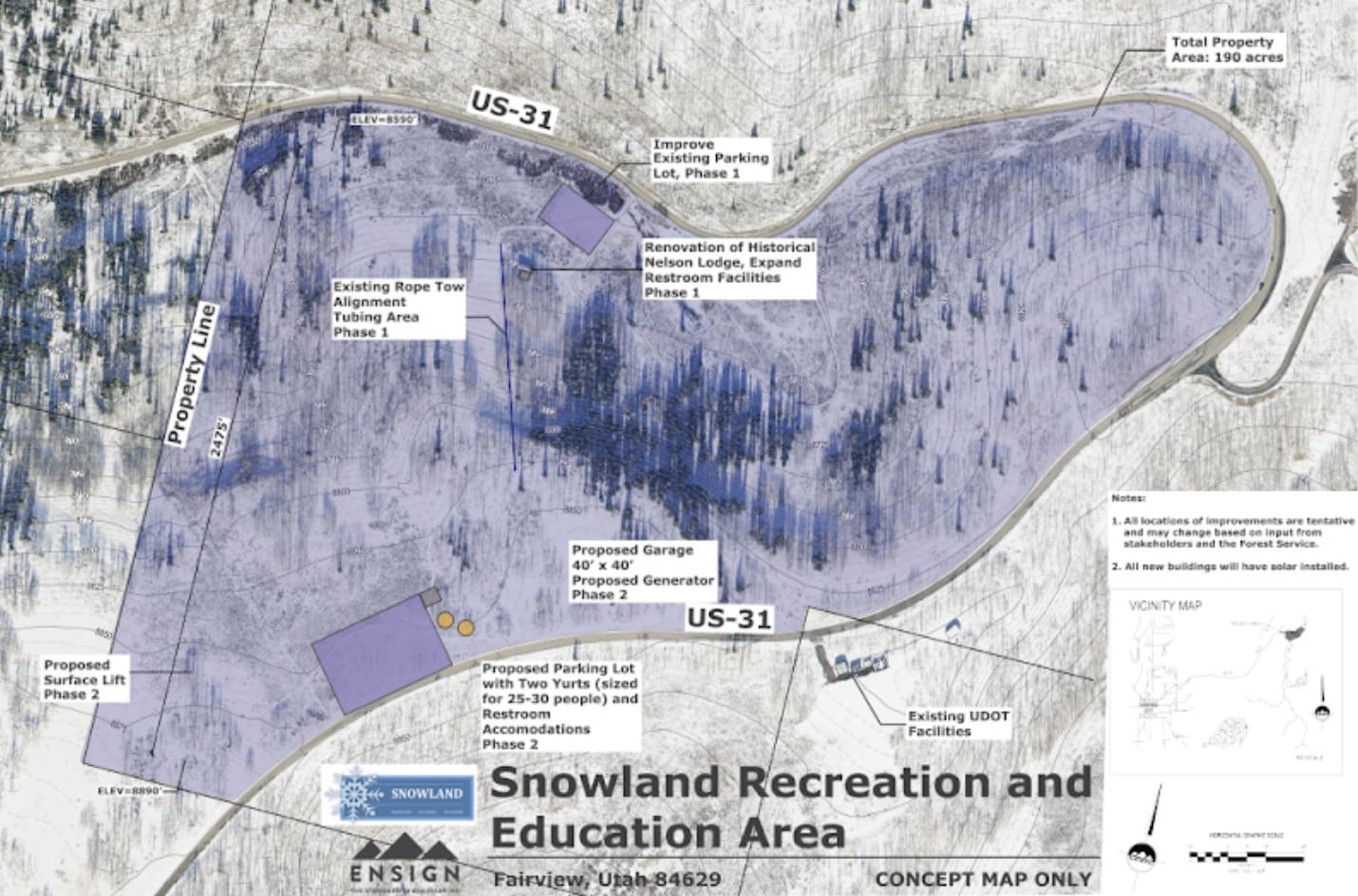
It won’t cost anything to access the hill this season, with the operational days expected to be on Fridays, Saturdays, and Sundays. During the other days, it will be used for recreational and educational purposes by Wasatch Academy and Snow College. The goal is to open for the 2025-26 season on December 6th.
When lift tickets get introduced, the prices are expected to be around $20, with season passes being an estimated cost of $100. The price structure and the ski area’s revival are inspired by Ascutney Outdoors, which has become a very successful comeback story of a once-shuttered Vermont ski resort. The goal is to have everything in place at Snowland by the 2027-28 season, but a few million dollars will need to be raised in order to see the proposal fully come to life.
Two challenges could complicate efforts. The first step is to expand the usable permit from 25 to 100 acres, and the second is to secure insurance. This permit expansion will need to be approved by the US Forest Service, which can become an extensive process. Insurance costs are a frequent issue faced by ski resorts today and will likely become a considerable expense for Snowland.
Personally, I’m excited about this development. Utah needs more ski areas, and feeder hills (small ski areas that serve as learning areas before they go to the bigger mountains) are a part of that. While the expansion efforts over at Deer Valley will help with skier congestion, there is still a need for more places to shred.
The ski industry knows that there’s a need for affordable opportunities to learn skiing and snowboarding. While ski resorts in the state have been working to make themselves more accessible, it can be intimidating for newcomers to visit these mountains. Snowland is the type of ski area that Utah needs to develop for skiers and riders to learn and grow.

Image/Video Credits: Ski Utah, Utah Department of Natural Resources, Snowland Foundation
