

Breaking Down the Numbers: Skiers and Snowboarders in the United States
Skiing and snowboarding are a cornerstone of American wintertime recreation, attracting millions to ski areas annually. The 2024-25 season recorded 61.5 million skier visits—the second-highest on record, up 1.7% from the previous year, showing that sliding down snow on skis and snowboards shows no signs of slowing down. But how many people ski and participate in snowboarding, and how do skiers and snowboarders compare? Using data from the National Ski Areas Association (NSAA), Statista, and industry reports, we look at total participation, the skier-snowboarder split, demographics, and trends, enhanced with charts for clarity.
Note: “Skier visits” includes both skiing and snowboarding trips to resorts.
Total Participation and Visits
Around 3% of the U.S. population (approximately 330 million) engages in skiing or snowboarding, highlighting how many people ski each year.
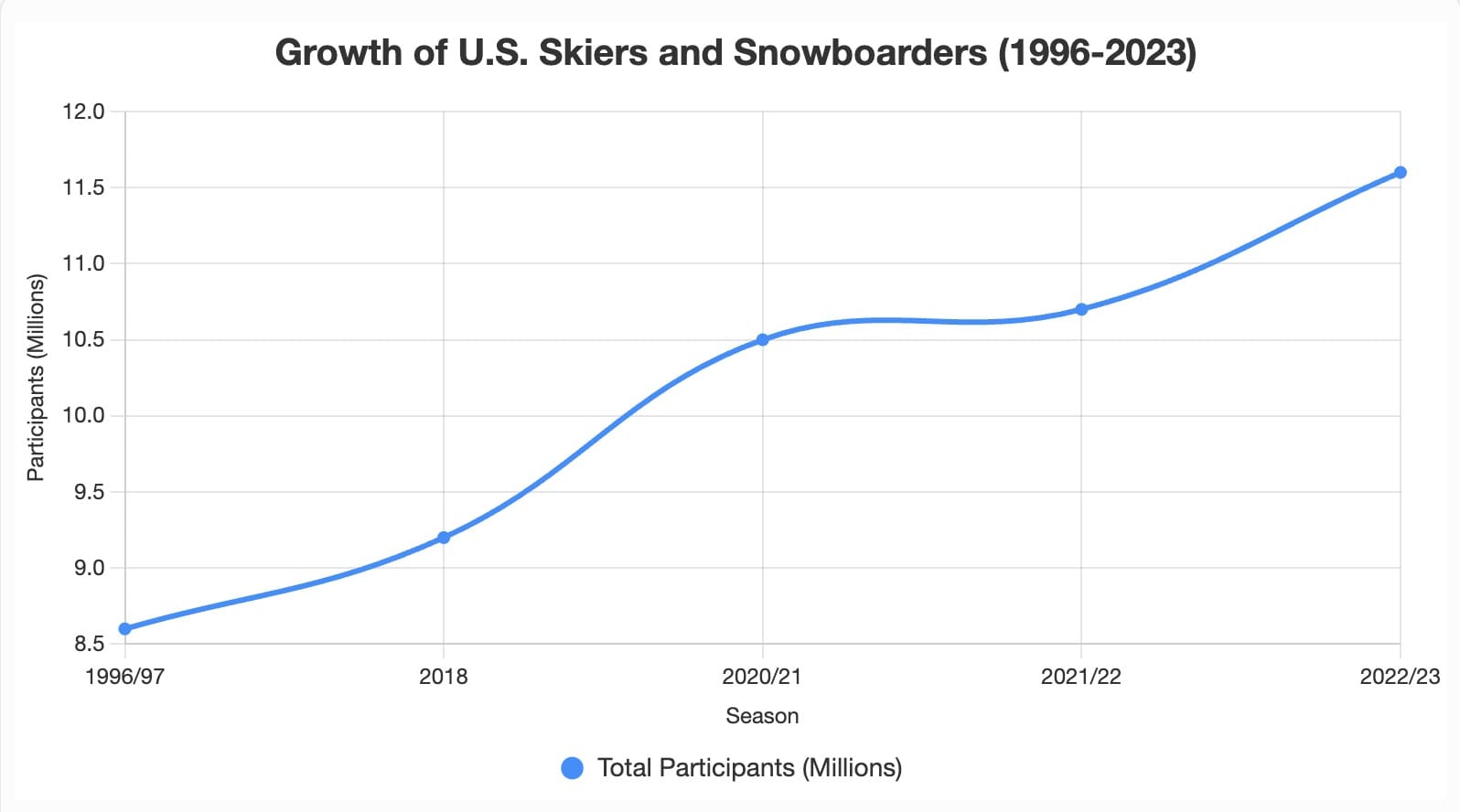
- Active Participants: In the 2022/23 season, 11.6 million unique individuals skied or snowboarded at least once, up from 10.7 million in 2021/22 and 8.6 million in 1996/97 (NSAA/Statista).
- Skier Visits: These track total days on the mountain. The 2024-25 season saw 61.5 million visits, following 60.4 million in 2023-24 and a peak of 65.4 million in 2022-23 (driven by heavy snowfall). On average, participants visit 5-6 times per season, though 5% of frequent riders (20+ days) drive a significant share of visits.
The industry, supported by 470+ resorts, generated $5.53 billion in 2023, with a projected 5% CAGR through 2030.
Breakdown: Skiers vs. Snowboarders
Skiing leads, but snowboarding maintains a strong presence. Some participants engage in both, so unique totals are less than the sum of skiers and snowboarders.
- Skiers: Approximately 14.9 million participants (Statista average, 2010-2023; 11.9 million in 2016).
- Snowboarders: Around 7.6 million participants (up from 7.1 million in 2018 to 7.6 million in 2020, per Snowsports Industries America).
- Ratio: Snowboarding accounts for 30-40% of activity, with skiing at 60-70%. Regional variations exist—some resorts report 50/50 splits, others 60/40 favoring snowboarders (Reddit discussions)—but national data tilts toward skiing.
Below is a chart visualizing the estimated participant split, which helps understand how many people ski compared to those who snowboard.
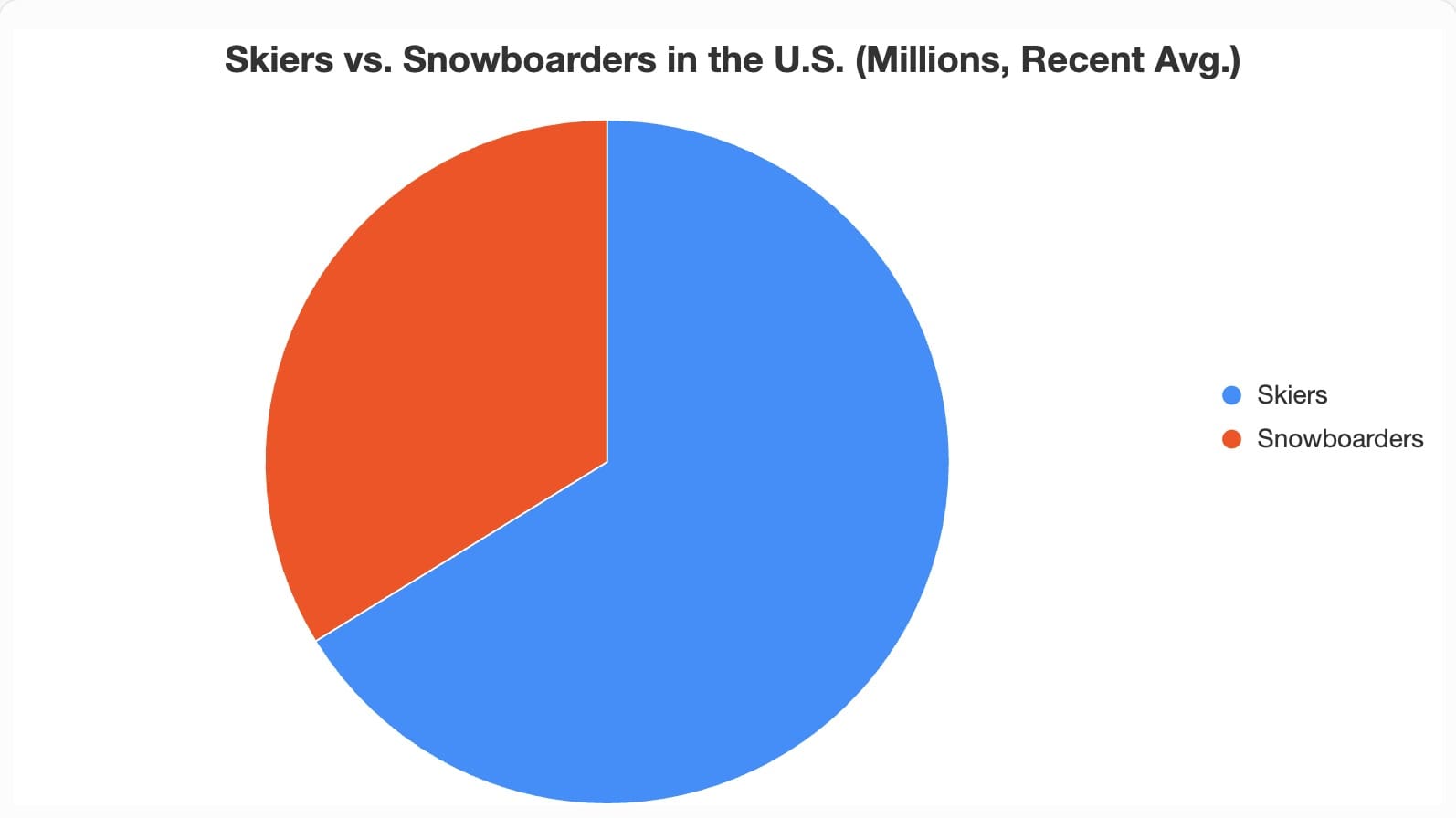
Note: The discrepancy between the 11.6 million unique active participants and the 14.9 million skiers plus 7.6 million snowboarders stems from overlap between the groups. The 14.9 million skiers and 7.6 million snowboarders are estimates of individuals engaging in each activity, but some people participate in both skiing and snowboarding. The 11.6 million figure, reported by the National Ski Areas Association (NSAA) for the 2022/23 season, represents unique individuals, counting each person only once regardless of whether they ski, snowboard, or do both.
For example, if someone skis and snowboards, they’re counted in both the 14.9 million and 7.6 million figures but only once in the 11.6 million total. This overlap explains why the sum (14.9 + 7.6 = 22.5 million) exceeds the unique participant count. Data from Statista and Snowsports Industries America supports this, noting that combined unique participants are less than the sum of activity-specific estimates due to dual participation.
Growth of Total Participants
Participation has grown steadily, with a notable spike during COVID-19 due to understandable reasons. From 8.6 million in 1996/97 to 11.6 million in 2022/23, the sport has expanded, though growth has leveled off post-pandemic, affecting how many people ski regularly. The chart below tracks this trend using available data points:
Demographics
The participant profile skews affluent and older, with growing diversity.
- Age: Median age is 35, up from 30 a decade ago and 24 in the 1960s. Baby boomers (55+) are 11% of participants (up from 7%), while 37.5% are 25 or younger.
- Gender and Diversity: Men lead slightly (55/45 split). Diversity is increasing through targeted initiatives.
- Income and Education: Average household income is $86,000; many are college-educated professionals.
- Helmet Use: 80% of those under 17 wear helmets, reflecting safety trends.
- Beginners: Over 1 million first-timers in 2020-21, but only 19% become regulars, a key challenge.
With 11.6 million active participants (14.9 million skiers, 7.6 million snowboarders) and 61.5 million visits in 2024-25, skiing and snowboarding remain vibrant in showing how many people ski. The charts highlight skiing’s dominance and steady participant growth. As the industry innovates and diversifies, there’s never been a better time to hit the slopes—whether on skis or a board! Sources: NSAA, Statista, Snowsports Industries America, Grand View Research. Data as of 2025.
