

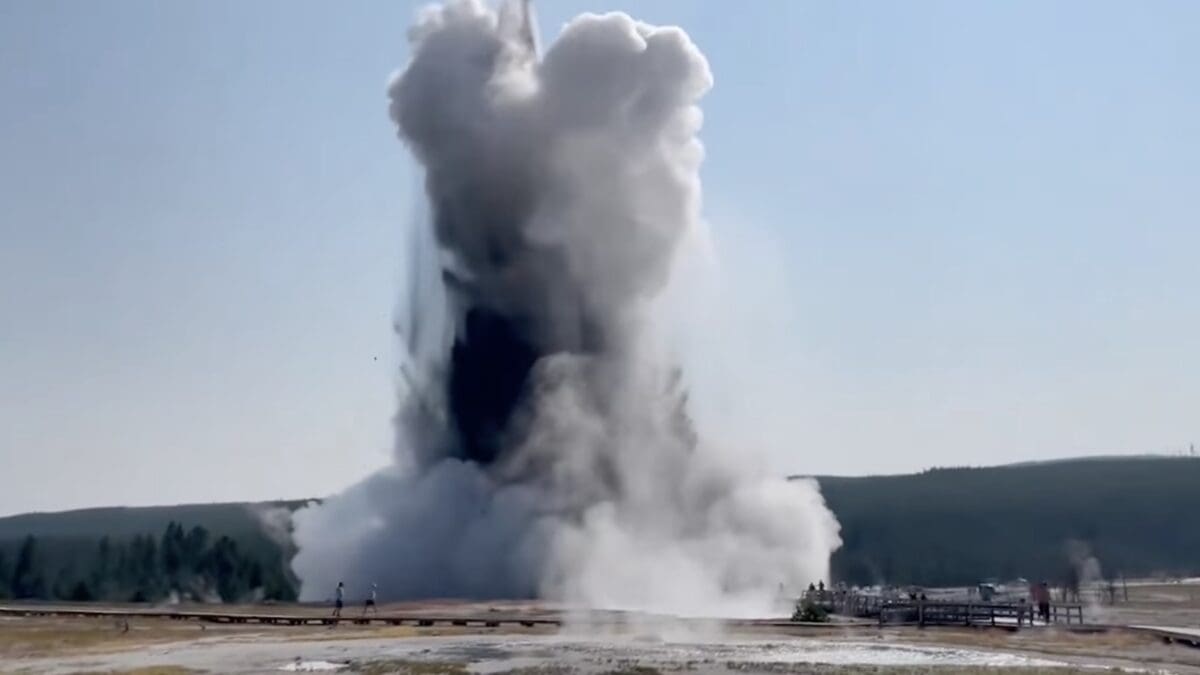
Just a bit over 1 year ago, the Black Diamond Pool in Yellowstone National Park erupted in a spectacular explosion. The July 23rd, 2024, Biscuit Basin hydrothermal explosion shot rocks and other materials hundreds of feet into the sky. Despite some rocks being a foot or more across, the explosion did not injure a single visitor. However the boardwalk did wind up heavily damaged and the Biscuit Basin area remains closed to this day. USGS Yellowstone Volcano Observatory Scientist-in-Charge Mike Poland recently provided an update on what’s been going on in the area.
Biscuit Basin Hydrothermal Explosion
The Biscuit Basin hydrothermal explosion that launched 1,500 rocks out of Black Diamond Pool destroyed the area’s boardwalk, leading to the closure, but that’s not the only reason the basin has remained closed. Based on evidence shown by the launched rocks, scientists can tell that the explosion was likely caused by a sealing of the system. All of the water that’s come up is packed full of minerals, and as those minerals drop out they clog up the plumbing system. Under those circumstances, pressure can build at pretty shallow levels, leading to explosions.
Since the original Biscuit Basin hydrothermal explosion, Black Diamond has seen several relatively small eruptions on occasion. At first, temperature records and seismic/acoustic readings showed hints of these explosions with only two eye witness reports. In mid-May, YVO installed a webcam pointed at the Black Diamond Pool. On May 31st, the camera captured its first eruption launching water up 20-30 feet.
With data from that eruption, the Yellowstone Volcano Observatory is able to determine that Black Diamond Pool has had eruptions every few days to weeks, with no discernible pattern as to how often they occur. With the lack of precursors to the explosions and the damage done to the boardwalk, Biscuit Basin has to remain closed.
Yellowstone Seismicity Update
The Yellowstone National Park region experienced a relatively quite month in terms of seismicity. The University of Utah Seismograph Stations picked up just 52 earthquakes in the area throughout July, with the largest being a magnitude 2.8 that occurred about 10 miles to the northeast of West Yellowstone, Montana, on July 30th.
