

Katmai National Park reminds us of what it means to be wild. The park was established in 1918 to protect a volcanically devastated region in Alaska. Now it protects 9,000 years of human history while acting as a vital habitat for both salmon and the thousands of grizzly bears that feed on them.
Katmai is home to around 2,200 brown bears with many more living on the Alaska Peninsula. The park provides unmatched bear viewing and study opportunities to both tourists and scientists. Upon arrival to Katmai’s Brooks Camp guests are asked to watch a bear safety orientation in order to keep them prepared and safe throughout their trip.
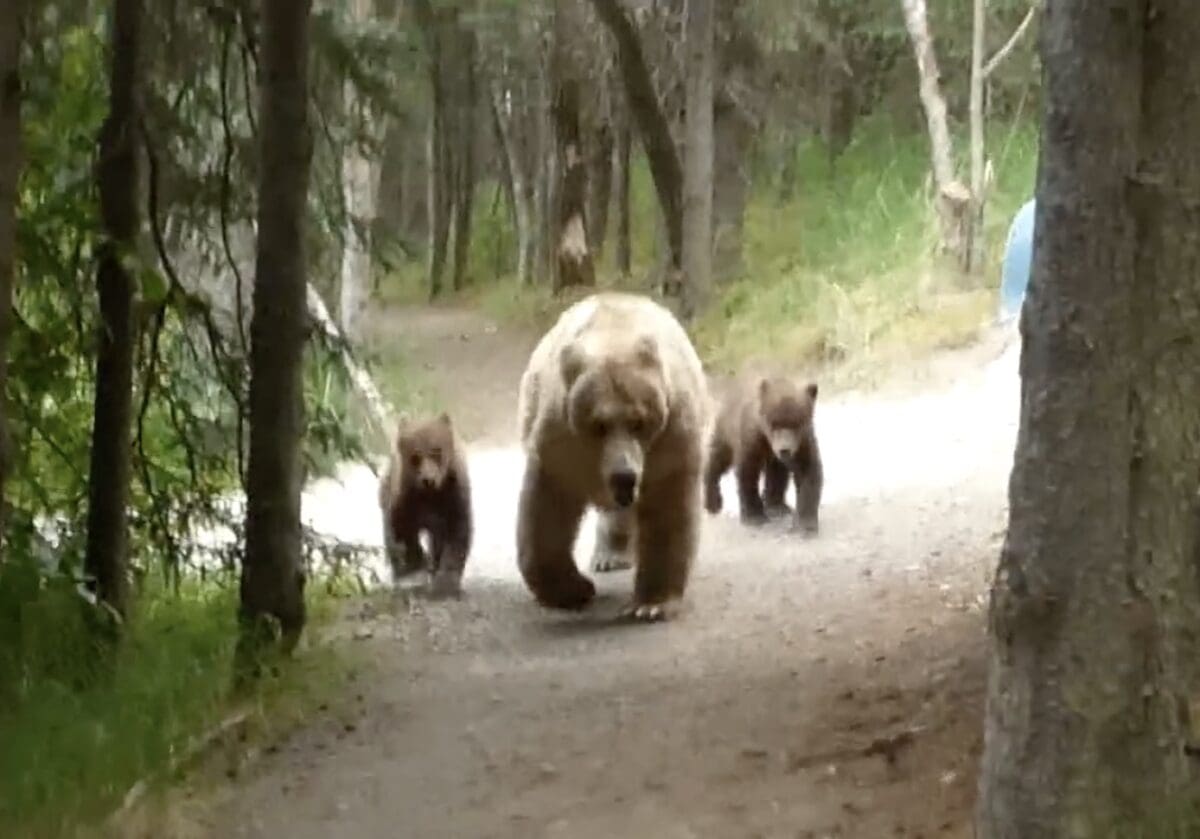
The following video was taken along a trail in Katmai National Park. The man behind the camera was walking back to camp when he came upon a mother grizzly and two cubs. He continuously faces towards the bears backing away in an attempt to avoid confrontation, but the three continue to walk towards him.
It’s very fortunate that this situation ended without the mother bear charging at the camera man, though the grizzly didn’t appear agitated or defensive throughout. In the event of a bear encounter one should slowly back away and attempt to give the animal as much space to pass as possible. It the animal continues to approach, you should stand your ground and make yourself look as big as possible. Carrying bear spray and knowing how to use it is a necessity in bear territory as well.
Bear Encounter Guidelines in Katmai National Park:
Assess the Bear’s Behavior
Bear encounters often happen very quickly, but the bear will likely be showing cues that communicate its intentions. When you encounter a bear always stop, remain calm, and assess the situation.
- Be Careful Not to Startle It: Shouting at a brown bear that is not aware of you may incite a charge. If the bear does not know you are there, back away quietly watching for any changes in its behavior.
- Look and Listen for Signs of Stress: Vocalizations like woofing, huffing, and jaw popping are almost always indications of stress. If you hear a bear vocalizing then the bear is most likely warning you. The position of a bear’s ears also communicates information. Ears that are pointed forward usually indicate a sense of curiosity or dominance. Ears that are flattened back on a bear’s head is indicative of stress and/or defensiveness.
Remain Calm and Do Not Run
A bear may approach closely or stand on its hind legs to identify you. Identify yourself as a human by talking to the bear calmly and waving your arms slowly above your head. Back away slowly if you can. If you are traveling in a group, use the group’s size to your advantage and stay close to one another. Don’t Run! Running may encourage a bear to chase you. Bears can run faster than 30 miles per hour (50 km/hr). You cannot outrun them.
If You are Charged
A defensive bear may approach you or even charge. If a bear charges, it perceives you as threat. Most charges are bluffs, but you must take action to try to appear non-threatening by standing your ground and talking calmly to the bear. Don’t shout or throw anything. Once the bear has stopped its charge, try to move slowly away. If the bear charges again as you are moving away, stop moving and stand your ground again.
Use your bear spray if you think the bear will attack. Even though most charges are bluffs, there is no cue from the bear indicating that the charge is a bluff.
If a Defensive Bear Attacks
Play dead. Fall to the ground face down on your stomach with your legs apart. Lock your hands behind your neck to protect your neck and face. If you do get rolled over, keep rolling until you’re face down again. Don’t shout or cry out. Stay quietly in this position until the bear has left the area. Once a defensive bear no longer perceives you as a threat, it will stop attacking. If the attack continues long after you have assumed the protective position, fight back vigorously.
If a Non-Defensive Bear Approaches
A non-defensive bear may approach you for are a variety of reasons — it may be conditioned to human food, curious, or want to test its dominance. Non-defensive bears usually don’t show any signs of stress, so you should act assertively. You are trying to dissuade the bear from approaching. As with a defensive bear, stay calm and speak to the bear. Try moving out of its way. If the bear continues to approach, you then want to assert your dominance over the animal — shout, make yourself look large and threatening, throw a rock towards the bear, and prepare to use your bear spray.
If a Non-Defensive Bear Attacks
In North America, brown bear attacks are very rare and non-defensive attacks by brown bears are even more rare. Brown bear attacks are almost always defensive, but if it is not then fight back. Non-defensive bears may consider you prey.
